

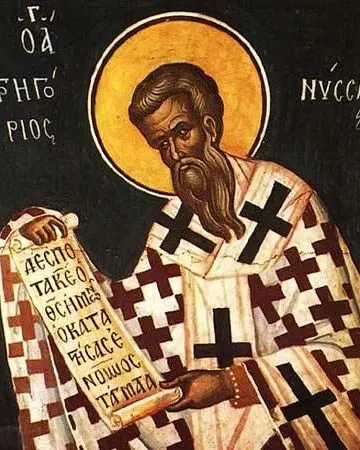
Saint Gregory of Nyssa
Bishop of Nyssa, one of the three Cappadocian Fathers, author of the Life of Moses
- Rank
- Saint
- Kind
- Bishop, Mystic
- Life
- ~335 – ~394
- Era
- 4th century
- Feast
- 10 January
- Countries
- Türkiye
Life story
Gregory was born around 335 into a Christian family that produced several saints, among them his brother Basil, bishop of Caesarea, and his sister Macrina. His birthplace is uncertain, possibly near Neocaesarea in Pontus. He trained in rhetoric and taught it, and only later took the path of the Church, under the influence of his brother and sister.
Around 372 Basil appointed him bishop of the small town of Nyssa. In 375 he was accused of embezzlement and irregular ordinations; he was arrested, escaped, and a synod deposed him in 376. He regained his see in 378, probably after an amnesty. He attended the Council of Constantinople in 381, where he was trusted in the debates on the Trinity.
He left many writings, among them Against Eunomius, Life of Moses, the Great Catechetical Oration, homilies on Ecclesiastes and the Song of Songs, and a life of his sister Macrina. He is also one of the few ancient writers who spoke out against slavery. He died around 394 or 395. In the Catholic Church his feast day is 10 January (since 2001; earlier it was 9 March). The Second Council of Nicaea (787) called him the “father of the Fathers”.
Works and witness
- Bishop of Nyssa from about 372
- Deposed in 376 and restored in 378
- Attended the Council of Constantinople in 381
- Wrote the Life of Moses and the Great Catechetical Oration
- One of the three Cappadocian Fathers
Saints from the same country
References
- Gregory of Nyssa, The Life of Moses, trans. Abraham Malherbe and Everett Ferguson (Paulist Press, 1978)
- Martyrologium Romanum (10 January)
- Council of Nicaea II (787), acts
Written by Anawim from documented history. Some details about ancient saints rest on tradition and are marked as such.