

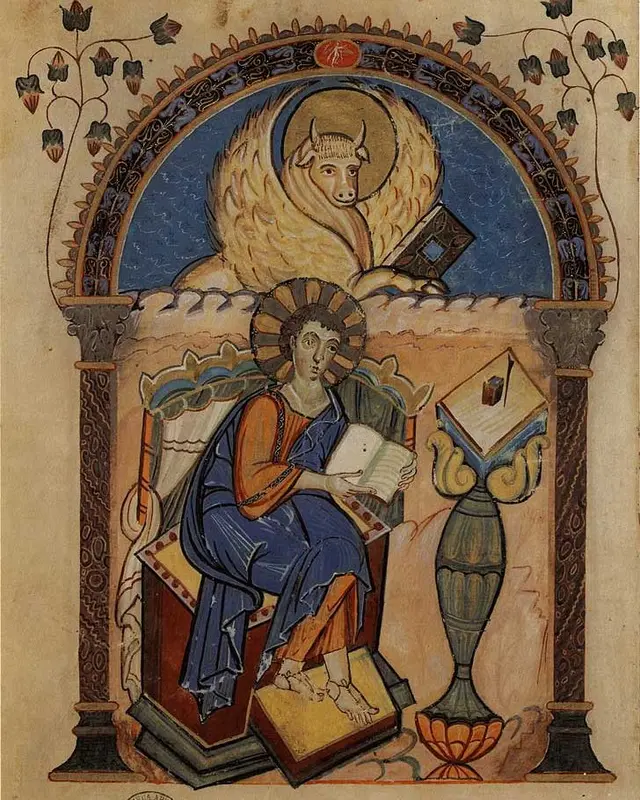
Saint Luke
Physician, and the writer of the third Gospel and the Acts of the Apostles
- Rank
- Saint
- Kind
- Evangelist
- Life
- d. ~84
- Era
- 1st century
- Feast
- 18 October
- Countries
- Türkiye, Greece, Italy
Life story
The New Testament tells very little about Luke. The letter to the Colossians calls him the beloved physician and distinguishes him from the Jewish co-workers of Paul, so he is usually understood to be a Gentile. According to Eusebius he came from Antioch, the great city of Syria. Scholars today treat this as tradition rather than certainty.
He accompanied Paul on several journeys and was still with him during his imprisonment, as the second letter to Timothy mentions. Some passages in the Acts of the Apostles use the word we, which many readers take as a sign that the author was travelling with Paul. From very early on, tradition attached his name to the third Gospel and to Acts, two works by the same author, written in polished Greek.
After Paul's death, everything told about Luke rests on tradition. According to several old sources, he never married, lived to about the age of 84 and died in Greece, possibly in Boeotia. His relics are said to have been moved to Constantinople in the fourth century, and a later medieval tradition links him with painting portraits of Mary, though there is no historical evidence for it. His feast is kept on 18 October, and the ox became his traditional symbol in Christian art. Careful historians of the ancient world value his two books because they describe places, officials and journeys with unusual precision for the time.
Works and witness
- Physician and companion of Paul on several journeys
- According to tradition, author of the third Gospel and the Acts
- Remained with Paul during his imprisonment, per 2 Timothy
- According to tradition, died in Greece at about 84
- Relics said to have been moved to Constantinople in the fourth century
Patron of
Physicians, Painters
Saints from the same country
References
- Tân Ước: Tin Mừng Luca, Công vụ Tông đồ, Côlôxê, 2 Timôthê (New Testament: Luke, Acts, Colossians, 2 Timothy)
- Eusebius, Church History
- Martyrologium Romanum
Written by Anawim from documented history. Some details about ancient saints rest on tradition and are marked as such.