

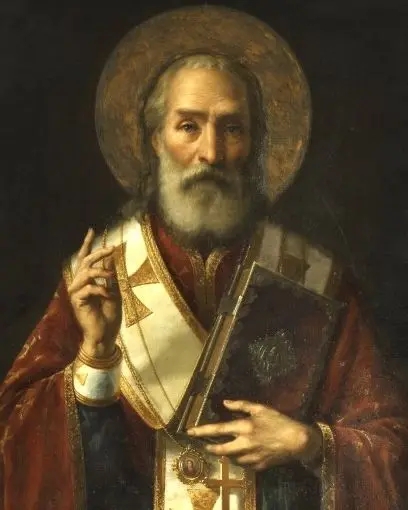
Saint Nicholas
Fourth-century bishop of Myra, remembered for his generosity
- Rank
- Saint
- Kind
- Bishop
- Life
- ~270 – ~343
- Era
- 4th century
- Feast
- 6 December
- Countries
- Türkiye, Italy
Life story
Nicholas was born in Patara, a port of Lycia in Asia Minor, around the end of the third century. He became bishop of Myra in the fourth century. Contemporary evidence is very thin, so what can be said with confidence is that he lived, served as bishop of Myra, and was venerated there soon after his death, traditionally dated around 343.
Most of what is told about him appeared later, from the sixth century onward. According to tradition he was imprisoned during the persecution and freed after Constantine recognised Christianity. Tradition also places him at the Council of Nicaea in 325, though his name is missing from the surviving lists. The story that he secretly gave dowries to three poor girls to spare them from ruin is a long-standing legend.
In 1087 sailors from Bari, in southern Italy, carried his relics from Myra to their own city, where a great basilica was built to house them. From then on his veneration spread widely in Europe.
His feast is on 6 December. In many Western countries his image gradually merged with the custom of giving gifts to children, which led to the figure of Father Christmas. The church of St Nicholas at Demre, the modern town beside ancient Myra, still stands. In the Eastern Churches he is among the best-loved saints, and in Greece and Russia he is widely honoured, especially by those who travel by sea.
Works and witness
- Served as bishop of Myra in Lycia in the fourth century
- According to tradition, secretly gave dowries to three poor girls
- His relics were brought to Bari by sailors in 1087
- His name is linked with the custom of giving children gifts on his feast
Patron of
Sailors, Children, City of Bari
Saints from the same country
References
- Martyrologium Romanum
- Dicastery for the Causes of Saints – biographical profile
- Vita sancti Nicolai (Michael the Archimandrite)
Written by Anawim from documented history. Some details about ancient saints rest on tradition and are marked as such.