

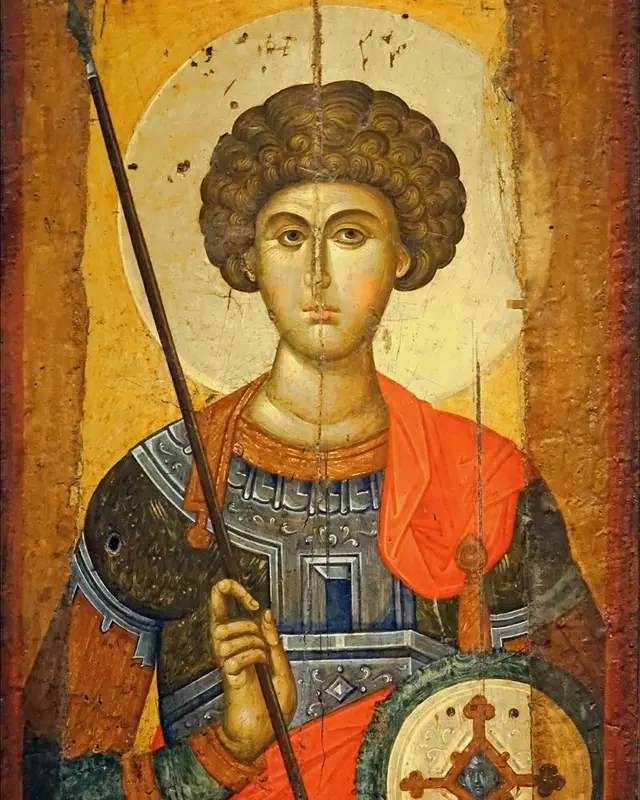
Saint George
A martyr of the Diocletian era honoured in East and West alike
- Rank
- Saint
- Kind
- Martyr
- Life
- d. ~303
- Era
- 4th century
- Feast
- 23 April
- Countries
- Türkiye, Israel, United Kingdom
Life story
George is among the most widely venerated martyrs of the early Church. Historical sources establish only that he was martyred, most likely during Diocletian's persecution around 303, and that devotion to him began early, with a church built over his tomb at Lydda, now Lod in Israel.
According to tradition he was born in Cappadocia in Asia Minor into a Christian family, entered the Roman army and rose to a high rank. When the persecution edicts came, he was arrested for refusing to renounce his faith. Later accounts describe many tortures, but these vary and cannot be verified. He is said to have been beheaded, and his remains were taken to Lydda.
The tale of the dragon slain to save a princess is absent from the earliest sources. It appears in the Middle Ages, notably in the Golden Legend, and spread quickly through the Crusades and through art.
From the fourteenth century George has been England's patron, and devotion to him is also strong in Georgia, Greece, Ethiopia and many other lands. His feast falls on 23 April. Devotion spread early from Palestine to Egypt, Syria and Constantinople, and later across Western Europe. In England it grew after King Edward III placed the Order of the Garter, founded around 1348, under his protection. The red cross on a white ground still bears his name. His name is also borne by the red-cross flag of England, and churches dedicated to him are found from Ethiopia to Britain.
Works and witness
- Martyred, most likely around 303, during the Diocletian persecution
- According to tradition, a Roman soldier from Cappadocia
- His tomb at Lydda soon became a pilgrimage site
- The dragon legend appears only in the Middle Ages
Patron of
England, Soldiers, Scouts
Saints from the same country
References
- Martyrologium Romanum
- Legenda aurea (Jacobus de Voragine)
- Dicastery for the Causes of Saints – biographical profile
Written by Anawim from documented history. Some details about ancient saints rest on tradition and are marked as such.