

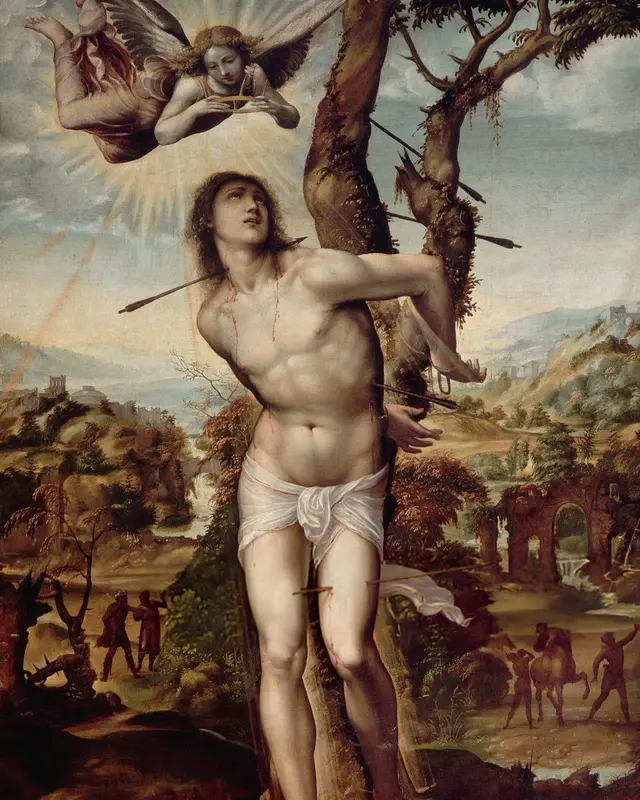
Saint Sebastian
A Roman soldier-martyr buried on the Appian Way
- Rank
- Saint
- Kind
- Martyr
- Life
- d. ~288
- Era
- 3rd century
- Feast
- 20 January
- Countries
- Italy, France
Life story
Sebastian is among the earliest martyrs honoured in Rome. His name appears in the calendar of 354, which marks 20 January as his day, and his tomb was visited in the catacombs along the Appian Way, where a basilica now bears his name. Little about his life can be stated with certainty.
The rest rests on a martyrdom account written much later, so it should be read as tradition. According to it, he was born at Narbonne but grew up in Milan, then joined the army and rose to command in the imperial guard under Diocletian. He is said to have hidden his faith in order to help Christians held in prison.
When he was discovered, tradition says, the emperor ordered archers to shoot him. Pierced by many arrows and left for dead, he was found alive by a woman named Irene, who came to collect the body and nursed him back to health. He then confronted the emperor over the persecution of Christians and was beaten to death with clubs, around 288.
His body was laid near the Appian Way, in the burial ground that later took his name. The image of a young man pierced by arrows became one of the most familiar subjects in Western Christian art, though that picture belongs to artistic tradition rather than to documented history. His feast is kept on 20 January, and the basilica on the Appian Way that bears his name remains a place of pilgrimage in Rome.
Works and witness
- Listed in the Roman calendar of 354 with a feast on 20 January
- According to tradition, an officer of Diocletian's guard
- According to tradition, survived being shot with arrows, then was clubbed to death
- Buried in the catacombs on the Appian Way, now the site of a basilica named for him
Patron of
Athletes, Soldiers
Saints from the same country
References
- Martyrologium Romanum
- Chronograph of 354 (Depositio martyrum)
- Passio sancti Sebastiani
Written by Anawim from documented history. Some details about ancient saints rest on tradition and are marked as such.