

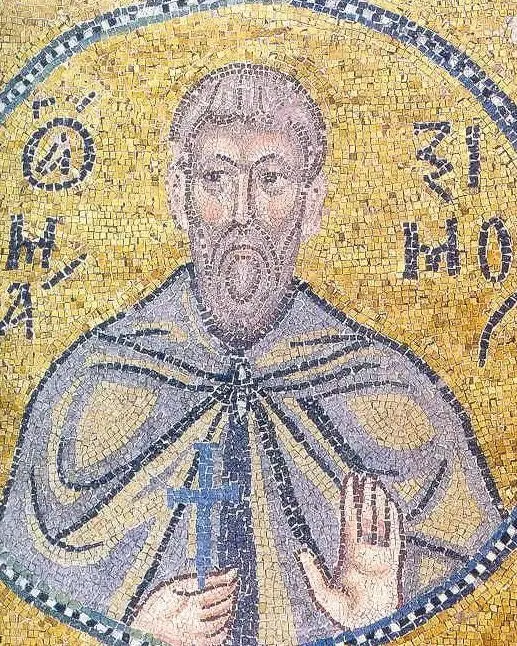
Saint Maximus the Confessor
Byzantine monk who defended two wills in Christ and suffered mutilation for it
- Rank
- Saint
- Kind
- Religious, Mystic
- Life
- 580 – 662
- Era
- 7th century
- Feast
- 13 August
- Countries
- Türkiye, Georgia
Life story
Maximus was born around 580. Two traditions about his origins differ: a Greek life says he was born in Constantinople into a noble family, while a Syriac life says he came from Hisfiyya in Palestine, so his birthplace cannot be fixed with certainty. He worked as an official and aide to the emperor Heraclius before leaving court to become a monk. He read deeply in Neoplatonist philosophy and the Church Fathers.
In the seventh century the emperor and the patriarch of Constantinople supported Monothelitism, the teaching that Christ had only a divine will. Maximus defended the position that Christ had both a human and a divine will. He may have helped draft the acts of the Lateran Council of 649 under Pope Martin I, which condemned the teaching.
In 653 Pope Martin I was arrested on the order of the emperor Constans II, and Maximus too was seized and taken to Constantinople. After a trial there in 655 he was exiled to Bizya in Thrace; in 662 he was tried again, had his tongue and right hand cut off, and was sent into exile in Lazica (modern Georgia). He died on 13 August 662. The Third Council of Constantinople (680 to 681) upheld his position. His feast day is 13 August.
Works and witness
- Left a post at court to become a monk
- Defended the teaching that Christ has two wills
- Seized and taken to Constantinople at the time of Pope Martin I's arrest
- Had his tongue and right hand cut off in 662
- Died in exile on 13 August 662
Saints from the same country
References
- Andrew Louth, Maximus the Confessor (Routledge, 1996)
- Martyrologium Romanum (13 August)
- Acts of the Lateran Council of 649 and the Third Council of Constantinople (680 to 681)
Written by Anawim from documented history. Some details about ancient saints rest on tradition and are marked as such.