

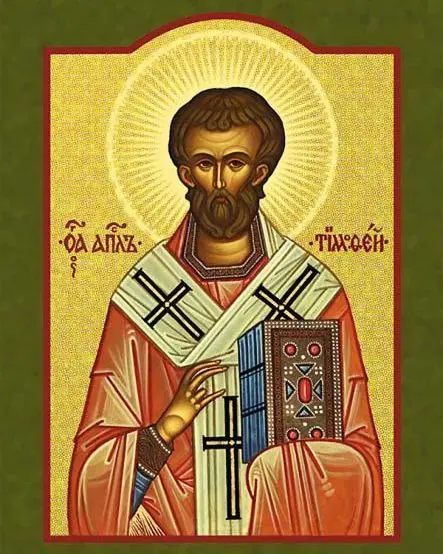
Saints Timothy and Titus
Two close co-workers of Saint Paul, honoured in the Pastoral Letters
- Rank
- Saint
- Kind
- Bishop, Missionary
- Life
- d. ~97
- Era
- 1st century
- Feast
- 26 January
- Countries
- Türkiye, Greece
Life story
Timothy came from Lystra in Asia Minor. His mother, Eunice, was a Jewish believer and his father was Greek. Paul met him on his second missionary journey, took him along and had him circumcised so that he could work more easily among Jews. From then on Timothy was one of Paul's closest helpers, named in the openings of several letters and sent more than once to visit the communities at Thessalonica, Corinth and Philippi. Two New Testament letters addressed to him give guidance on caring for a congregation.
Titus was of Gentile origin and uncircumcised. Paul took him to Jerusalem when the terms for accepting non-Jews were discussed there. Paul's letters to Corinth show Titus being sent to that city to ease tensions in the community and to collect money for the church in Jerusalem. The Letter to Titus says Paul left him on the island of Crete to put things in order and appoint leaders for the communities.
According to tradition, Timothy was the first bishop of Ephesus and died as a martyr toward the end of the first century, though detailed accounts appear fairly late and are hard to verify. Tradition also makes Titus bishop of Crete, where he died at an advanced age. A church named after him stands in Heraklion on Crete. Since 1970 the Latin Church has kept their feast together on 26 January, the day after the Conversion of Saint Paul.
Works and witness
- Timothy, son of a Jewish mother and Greek father, travelled with Paul from the second journey
- Titus, of Gentile origin, was sent by Paul to deal with matters in Corinth
- Two letters to Timothy and one to Titus are part of the New Testament
- By tradition, Timothy led Ephesus and Titus led the island of Crete
- The two are celebrated together on 26 January
Saints from the same country
References
- Tân Ước / New Testament (Acts 16; 1-2 Timothy; Titus; 2 Corinthians)
- Martyrologium Romanum
- Eusebius of Caesarea, Historia Ecclesiastica
Written by Anawim from documented history. Some details about ancient saints rest on tradition and are marked as such.