

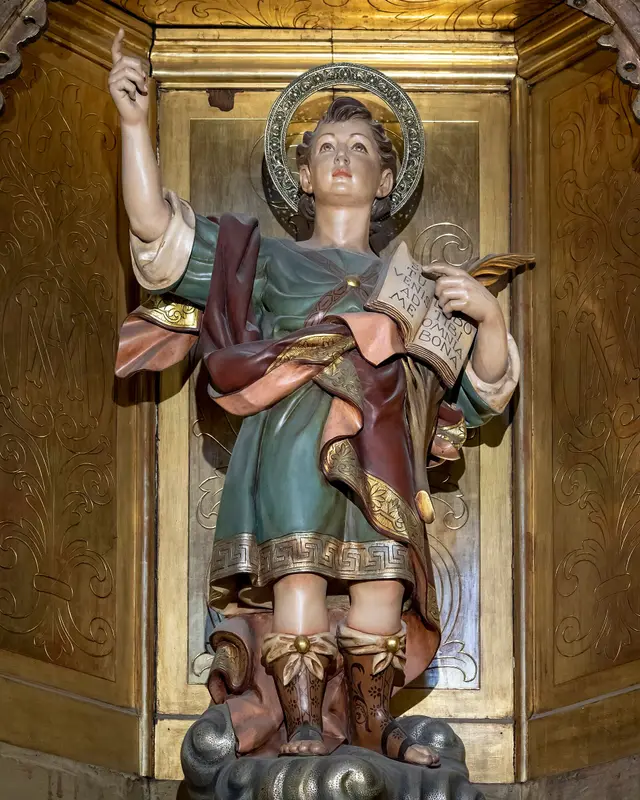
Saint Pancras
Teenage martyr of Rome whose burial place became a basilica
- Rank
- Saint
- Kind
- Martyr, Young saint
- Life
- d. ~304
- Era
- 4th century
- Feast
- 12 May
- Countries
- Türkiye, Italy
Life story
The story of Pancras is mostly legend. It says he was born near Synnada in Phrygia (modern Turkey) to a family of Roman citizens; his mother died in childbirth and his father soon after. He and his uncle Dionysius moved to Rome, where Pope Marcellinus brought them to the faith. His name is Greek and means all-powerful.
Tradition adds that he refused Emperor Diocletian's offer of wealth and power if he would sacrifice to the gods, and was beheaded on the Via Aurelia on 12 May 303 or 304, aged about fourteen. A woman named Octavilla recovered his body and buried it in the catacombs.
The passio is a late text, so the details of the story cannot be treated as confirmed history. What is certain is that devotion to him is very old.
Pope Symmachus (498 to 514) built a basilica over his burial place, now San Pancrazio in Rome. Bede records that Pope Vitalian sent relics of Pancras, among others, to King Oswiu of Northumbria in the 660s. His feast is 12 May.
Works and witness
- According to tradition, a boy beheaded in Rome for refusing to sacrifice to the gods
- A basilica was built over his tomb under Pope Symmachus
- Relics sent to King Oswiu of Northumbria by Pope Vitalian in the 660s
- The basilica of San Pancrazio in Rome stands over his burial place
Patron of
Children (popular tradition)
Saints from the same country
References
- Bede, Ecclesiastical History III.29 (letter of Pope Vitalian to King Oswiu)
- Catholic Encyclopedia, "Early Roman Christian Cemeteries" (newadvent.org/cathen/03510a.htm)
Written by Anawim from documented history. Some details about ancient saints rest on tradition and are marked as such.