

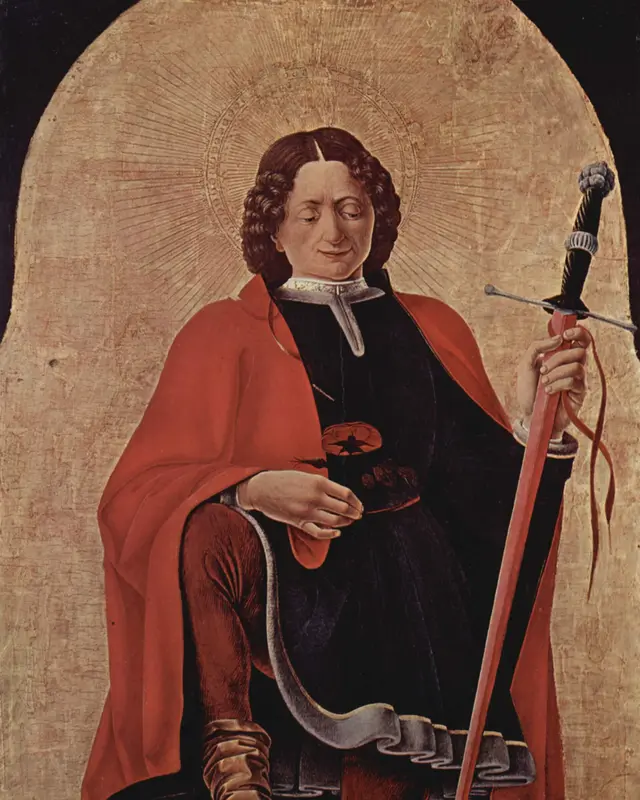
Saint Florian
Roman official in Noricum, drowned in the river Enns under Diocletian
- Rank
- Saint
- Kind
- Martyr
- Life
- d. ~304
- Era
- 4th century
- Feast
- 4 May
- Countries
- Austria
Life story
Tradition says Florian came from Aelium Cetium, now Sankt Pölten in Austria. He is described as a former head of the imperial administration at Lauriacum (Lorch) in the province of Noricum. These details come from the passio, a text of the late eighth or ninth century, so they are traditional rather than firmly documented.
During the persecution of Diocletian, an official named Aquilinus was sent to investigate Florian for not enforcing the edicts against Christians. He refused to sacrifice to the Roman gods and was sentenced to be burned. One account says he dared the soldiers to light the fire, but instead they tied a millstone to his neck and drowned him in the Enns, around 304.
According to legend, Christians recovered his body and buried it near Lorch; later a woman named Valeria is said to have dreamed that he asked to be moved, and his remains were taken to the site of the later monastery of St. Florian. A medieval Polish tradition says that relics were sent to Kraków in the twelfth century at the request of Prince Casimir, and Kraków claims some of them.
He is invoked against fire and floods and is the patron of firefighters. The story that he stopped a fire with a single pitcher of water, which is why he is shown holding one, is also legend. His feast is 4 May.
Works and witness
- According to tradition, a Roman official in the province of Noricum
- Refused to sacrifice to the gods in Diocletian's persecution
- Drowned in the river Enns around 304
- Relics reached Kraków in the twelfth century, according to Polish tradition
Patron of
Firefighters, Chimney sweeps, Upper Austria, Poland
Saints from the same country
References
- Austria-Forum, "Florian von Lorch" (austria-forum.org)
- Catholic Encyclopedia, "Austro-Hungarian Monarchy" (newadvent.org/cathen/02121b.htm)
Written by Anawim from documented history. Some details about ancient saints rest on tradition and are marked as such.