

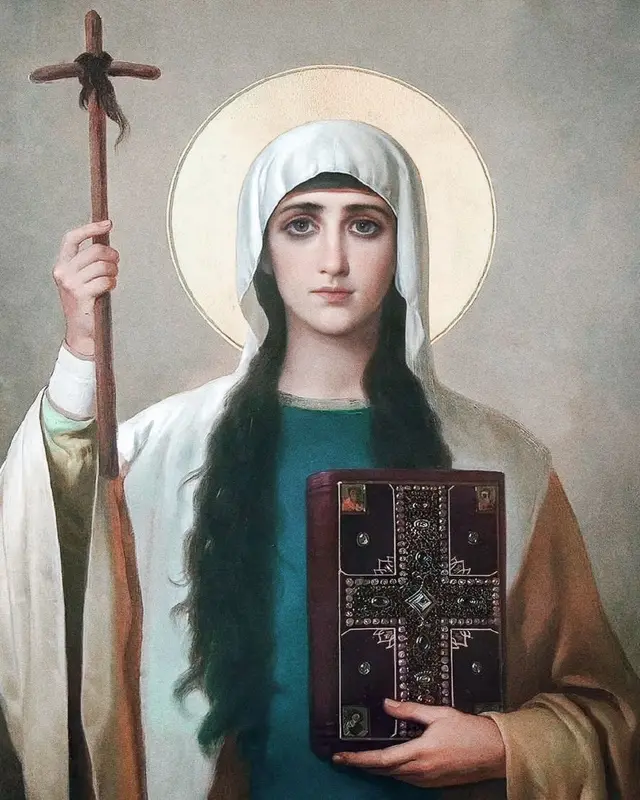
Saint Nino of Georgia
Woman missionary who, by tradition, led the kingdom of Iberia to Christianity
- Rank
- Saint
- Kind
- Missionary, Virgin
- Life
- b. ~296
- Era
- 3rd century
- Countries
- Türkiye, Georgia
Life story
Tradition says Nino was born around the 280s or 290s in Cappadocia, was Greek-speaking, and was related to Saint George. Orthodox biographies add that her father was a Roman officer and her mother a sister of Patriarch Juvenal of Jerusalem. All of these details are traditional; no contemporary document confirms them.
The oldest source is the historian Rufinus, around 403, who recorded what he had heard from a Georgian prince. According to him a Christian woman held captive healed many people in Iberia. Tradition adds that the Virgin Mary gave her a cross made of vine branches, and that King Mirian III, caught in darkness on a hunt, prayed to the God of Nino and the light returned. These are traditional stories, not secure history.
Mirian is said to have converted and made Christianity the religion of the kingdom around 326 (Britannica says about 330). Nino died at Bodbe in Kakheti, about the 320s or 330s, and her tomb is venerated at Bodbe Monastery. The Georgian Orthodox Church and other Eastern churches venerate her, and her main feast is on 14 January.
Works and witness
- By tradition, came to Iberia (modern Georgia) preaching the Gospel
- According to Rufinus, healed many people while a captive
- Tradition links King Mirian's conversion to a prayer to her God
- Died at Bodbe, where her tomb is venerated
- Her vine cross is a symbol of Georgian Christianity
Saints from the same country
References
- Orthodox Church in America, Lives of the Saints: Saint Nino (Nina), Equal of the Apostles, Enlightener of Georgia
- Rufinus of Aquileia, Ecclesiastical History (cited via Wikipedia; not read directly)
- Wikipedia article on Saint Nino (read in full; sources, dates, legends flagged)
Written by Anawim from documented history. Some details about ancient saints rest on tradition and are marked as such.