

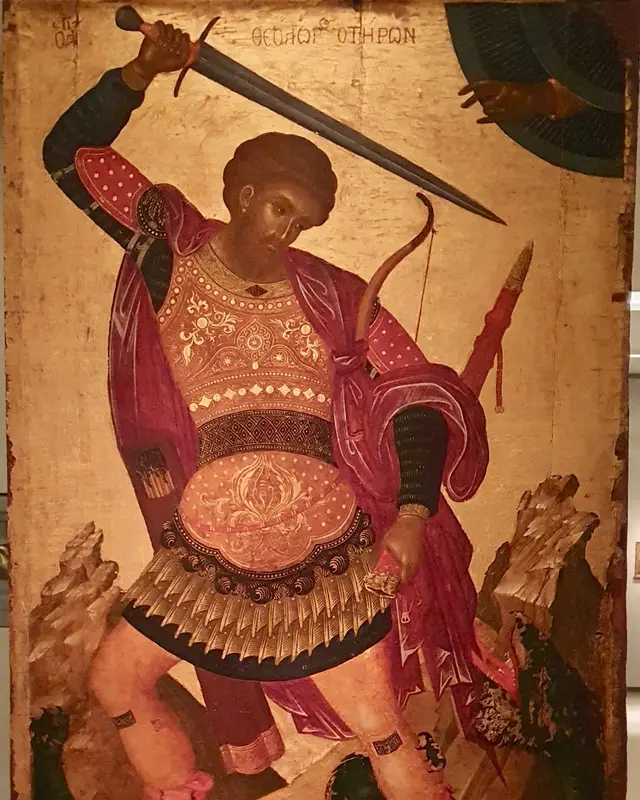
Saint Theodore of Amasea
Soldier martyred at Amasea, praised by Gregory of Nyssa
- Rank
- Saint
- Kind
- Martyr
- Life
- d. ~306
- Era
- 4th century
- Feast
- 9 November
- Countries
- Türkiye
Life story
According to tradition Theodore was a Greek legionary burned to death at Amasea, now Amasya in Turkey, during Diocletian's Great Persecution. Later tradition gives the date as 17 February 306, while the Golden Legend gives 287, so the year of death is uncertain.
The narrative says he refused to sacrifice to the gods, confessed Christ, burned a temple of the goddess Cybele, and was then tortured and executed. According to tradition his body was taken to Euchaita and venerated there. These are legendary accounts, and many later additions followed, including the dragon-slaying motif that was afterwards transferred to Saint George.
The earliest evidence for his veneration is a panegyric preached by Gregory of Nyssa around 381. Gregory's sermon was preached at the shrine of Euchaita, to which the Catholic Encyclopedia says his body was taken. Whether Theodore Stratelates was a distinct person from Theodore the Recruit is doubtful, and the two saints were often confused.
The Eastern churches keep his feast on 17 February and on the first Saturday of Lent; the old Western date was 9 November and survives only in some local calendars. He is venerated as patron of soldiers and was an early patron of Venice before Saint Mark, though the Venetians did not clearly distinguish him from Theodore Stratelates.
Works and witness
- According to tradition, a Roman soldier burned at Amasea
- Praised by Gregory of Nyssa around 381
- His relics were moved to Euchaita
- Early patron saint of Venice
Patron of
Soldiers, The city of Brindisi
Saints from the same country
References
- Catholic Encyclopedia, "St. Theodore of Amasea" (newadvent.org/cathen/14573a.htm)
Written by Anawim from documented history. Some details about ancient saints rest on tradition and are marked as such.