

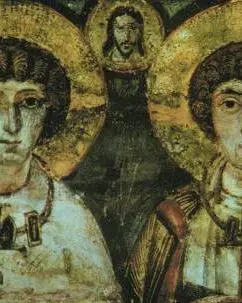
Saints Sergius and Bacchus
Two Syrian soldier-martyrs honoured since the fifth century
- Rank
- Saint
- Kind
- Martyr
- Feast
- 7 October
- Countries
- Syria
Life story
Sergius and Bacchus are venerated as fourth-century Syrian soldier-martyrs by Catholic, Orthodox and Oriental Orthodox churches. Their story is told in a Greek Passion set under the emperor Galerius (305-311), though the text contains contradictions and details that do not fit that period.
According to the Passion, the emperor favoured them as officers until they were exposed as secret Christians for refusing to sacrifice to Jupiter. They were paraded in women's clothing, then sent to Barbalissos in Mesopotamia, where Bacchus was beaten to death. Sergius was tortured and later executed at Resafa; accounts say that miracles marked his death.
At Resafa a shrine to Sergius was built and the city was renamed Sergiopolis around 425. A stone basilica followed in 518 and the place became a major pilgrimage centre. In Constantinople the church of Little Hagia Sophia was dedicated to the two saints around 527-536 under Justinian I.
Many scholars date the Passion to the mid-fifth century, and there is no evidence of their cult before about 425, although some accept parts of the account. The details of the martyrdom should therefore be treated as tradition rather than confirmed history. Their feast is 7 October.
Works and witness
- Venerated as two soldier-martyrs of Syria
- According to tradition, refused to sacrifice to Jupiter
- Shrine of Sergius at Resafa became a major pilgrimage site; the city was called Sergiopolis around 425
- Little Hagia Sophia in Constantinople dedicated to them (about 527-536)
Saints from the same country
References
- Britannica, "Saints Sergius and Bacchus"
- Catholic Encyclopedia (1913), "Sergius and Bacchus" (dates the martyrdom c. 303 and calls the Acts not genuine)
Written by Anawim from documented history. Some details about ancient saints rest on tradition and are marked as such.