

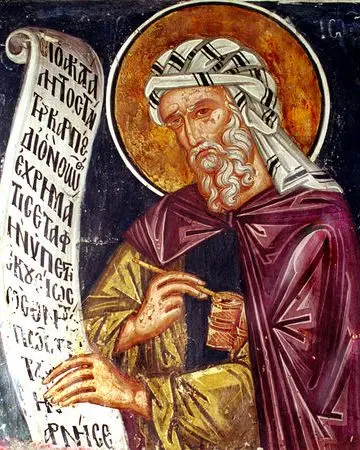
Saint John of Damascus
Priest and monk of Mar Saba who defended the veneration of holy images
- Rank
- Saint
- Kind
- Doctor of the Church, Priest
- Life
- 675 – 749
- Era
- 8th century
- Feast
- 4 December
- Countries
- Syria, Palestinian Territories
Life story
John was born around 675 in Damascus, to a prominent Arab Christian family. His father, and probably he himself, held a financial office at the court of the Umayyad caliphs, who then ruled Syria. Tradition says he received a careful education, but these details about his youth come from a later biography and should not be considered certain. Some accounts mention a monk named Cosmas, a former captive, as his tutor, but this too comes from the later biography and cannot be verified.
Leaving court work, he entered the monastery of Mar Saba in the desert near Jerusalem, now in the West Bank, and by tradition was ordained a priest in Jerusalem. From then on he devoted himself to prayer and writing. During the period when the Byzantine emperor Leo III forbade holy images, he wrote three treatises defending their veneration, and because he lived under Muslim rule he could write more freely than authors within Byzantine territory.
His main work is the Fount of Knowledge, in three parts, of which the last, An Exact Exposition of the Orthodox Faith, summarises the teaching of the Greek Fathers. He also composed many hymns and liturgical canons that are still used in the Eastern Churches. He died at Mar Saba, usually dated 749, though the year is not certain. Pope Leo XIII declared him a Doctor of the Church in 1890. His writings were later translated into Latin and strongly influenced Western scholastic theology, which cited him often.
Works and witness
- Born in Damascus around 675; served the Umayyad court
- Entered the monastery of Mar Saba near Jerusalem
- Wrote three treatises defending the veneration of images
- Composed the Fount of Knowledge, including the Exact Exposition of the Orthodox Faith
- Declared Doctor of the Church in 1890
Saints from the same country
References
- John of Damascus, Fons scientiae (Pege gnoseos)
- John of Damascus, Orationes de imaginibus
- Martyrologium Romanum
Written by Anawim from documented history. Some details about ancient saints rest on tradition and are marked as such.