

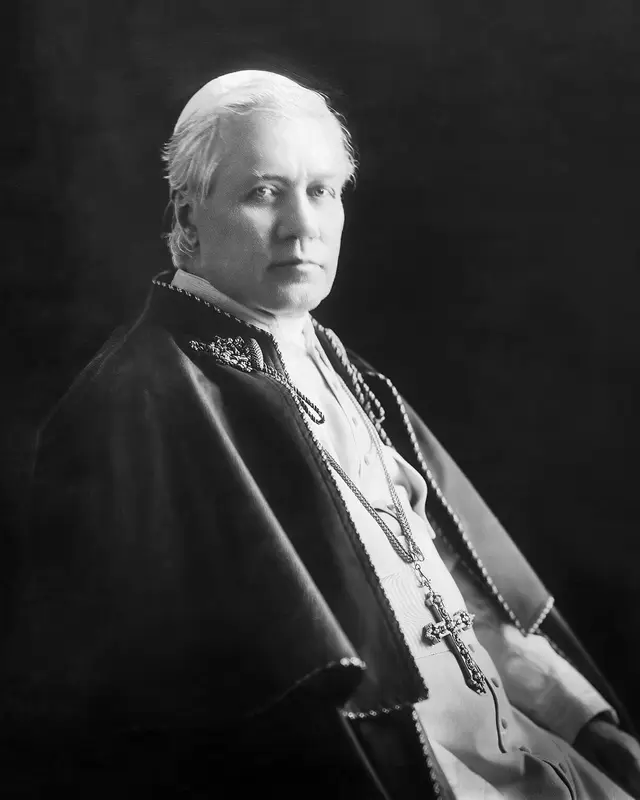
Saint Pius X
Son of a municipal messenger who became the Pope who encouraged frequent communion
- Rank
- Saint
- Kind
- Pope
- Life
- 1835 – 1914
- Era
- 20th century
- Feast
- 21 August
- Countries
- Italy, Vatican City
Life story
Giuseppe Melchiorre Sarto was born on 2 June 1835 at Riese, in the Veneto, into a poor family with many children; his father worked for the local authority. He studied at the seminary in Padua and was ordained a priest in 1858. He served as an assistant priest and then as parish priest of Salzano, where he gave attention to catechesis and to helping the poor.
He became bishop of Mantua in 1884 and then cardinal and patriarch of Venice in 1893. In August 1903 he was elected pope and took the name Pius X. During his pontificate he called for reform of sacred music with a document of 1903, encouraged frequent communion with a decree of 1905, and in 1910 allowed children who had reached the age of reason to make their first communion.
He also reorganised the Roman Curia, began the work of drawing up a Code of Canon Law, which was published in 1917 under Benedict XV, and stressed catechetical teaching. In 1907 he issued the encyclical Pascendi against theological modernism, a decision that is still debated by scholars.
He died on 20 August 1914, a few weeks after the outbreak of the First World War. He was beatified in 1951 and canonised by Pius XII in 1954. He was known in life for a simple way of living and for his origins among the poor, and he continued to be remembered in Venice and in his native Veneto as a pastor close to ordinary people. His tomb is in St Peter's Basilica.
Works and witness
- Priest, bishop of Mantua and patriarch of Venice
- Elected pope in August 1903
- Reformed sacred music and encouraged frequent communion
- Allowed first communion at the age of reason in 1910
- Began the preparation of the Code of Canon Law
Saints from the same country
References
- Martyrologium Romanum
- Dicastery for the Causes of Saints – biographical profile
- Acta Apostolicae Sedis
Written by Anawim from documented history. Some details about ancient saints rest on tradition and are marked as such.