

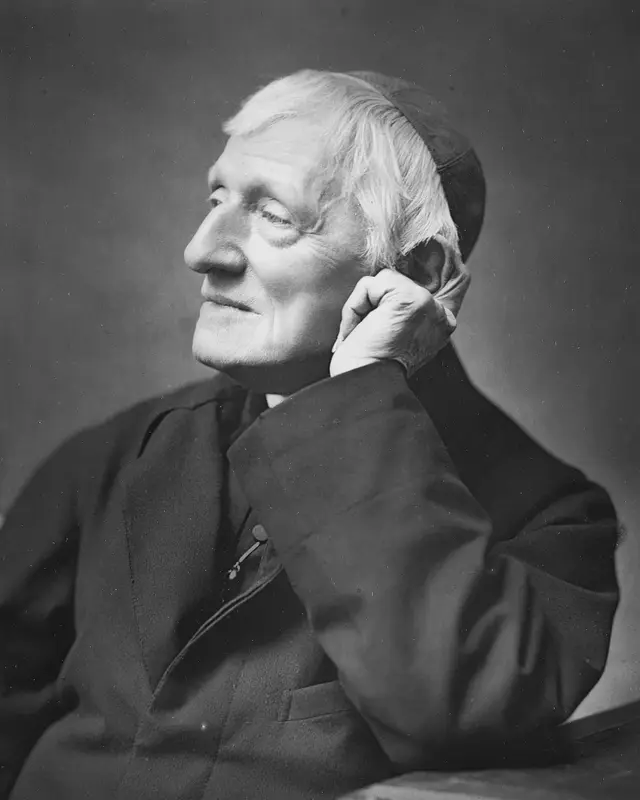
Saint John Henry Newman
Oxford Anglican clergyman who became a Catholic cardinal and a major writer
- Rank
- Saint
- Kind
- Priest
- Life
- 1801 – 1890
- Era
- 19th century
- Feast
- 9 October
- Countries
- United Kingdom
Life story
Newman was born in London on 21 February 1801, studied at Oxford and in 1822 was elected a fellow of Oriel College. He was ordained in the Church of England and from 1828 was vicar of St Mary's, Oxford, where his sermons drew many students. In the 1830s he became a leading figure of the Oxford Movement and contributed to the Tracts for the Times.
After studying the history of the Church Fathers, and after the controversy over Tract 90 in 1841, he withdrew to Littlemore. On 9 October 1845 he was received into the Catholic Church by the Passionist Dominic Barberi. He was ordained a Catholic priest in Rome in 1847 and founded the Oratory of St Philip Neri in Birmingham in 1848, where he spent most of the rest of his life.
He served as rector of the Catholic University in Dublin from 1854, and the lectures of those years were gathered in The Idea of a University. He also wrote the Apologia Pro Vita Sua in 1864 to explain his path to the Catholic Church, the poem The Dream of Gerontius in 1865 and An Essay in Aid of a Grammar of Assent in 1870. He left a large body of letters and sermons.
In 1879 Leo XIII made him a cardinal. He died on 11 August 1890 at Edgbaston, Birmingham. Benedict XVI beatified him in 2010 during a visit to the United Kingdom, and Pope Francis canonised him on 13 October 2019.
Works and witness
- Vicar of St Mary's, Oxford, and leading figure of the Oxford Movement
- Entered the Catholic Church on 9 October 1845
- Founded the Birmingham Oratory in 1848
- Wrote the Apologia Pro Vita Sua and The Idea of a University
- Made a cardinal in 1879
Saints from the same country
References
- Martyrologium Romanum
- Dicastery for the Causes of Saints – biographical profile
- John Henry Newman, Apologia Pro Vita Sua
Written by Anawim from documented history. Some details about ancient saints rest on tradition and are marked as such.