

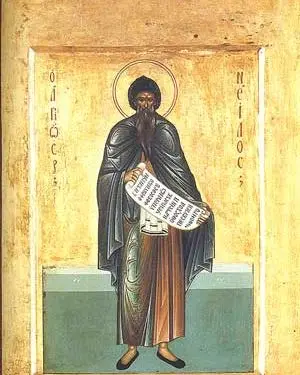
Saint Nilus of Sinai
Former Constantinople official turned Sinai hermit, writer of letters and treatises on monastic life
- Rank
- Saint
- Kind
- Religious, Mystic
- Feast
- 12 November
- Countries
- Türkiye, Egypt
Life story
According to the traditional biography he was born around 365; sources disagree about the place, some saying Constantinople and others Ancyra in Galatia. He was a layman, married with two children, and is said to have held the post of eparch (city prefect) of Constantinople while still young; this comes from a legendary biography and is treated only as tradition. He was a disciple of John Chrysostom, who shaped his study of Scripture and his piety. Between about 390 and 404, he and his wife agreed to separate so that he could follow monastic life.
According to the same tradition, he went to Mount Sinai with his son Theodulos, and the two lived in a cave for about forty years. Around 410 Saracen raiders captured Theodulos and sold him into slavery. Nilus found his son at Elusa, and the bishop there ordained both men as priests before they returned to Sinai.
He wrote on heresy, paganism, asceticism and monastic life, and left a large body of letters; his Ascetic Discourse appears in the English Philokalia. He also corresponded with the Gothic leader Gainas and denounced the persecution of John Chrysostom. He was certainly alive in 430; most reference works put his death about 430, and some writers as late as 451. His feast is 12 November.
Works and witness
- Held an official post in Constantinople before turning to monastic life, per the traditional biography
- Went to Sinai with his son Theodulos and lived in a cave for about forty years
- Found his son, captured by Saracens, and both were ordained priests
- Wrote letters and treatises on asceticism, one of them in the Philokalia
Saints from the same country
References
- Catholic Encyclopedia (1913), "St. Nilus" (catholic.org/encyclopedia)
- Encyclopedia.com, "Nilus of Ancyra, St."
- Britannica, "Saint Nilus of Ancyra"
Written by Anawim from documented history. Some details about ancient saints rest on tradition and are marked as such.