

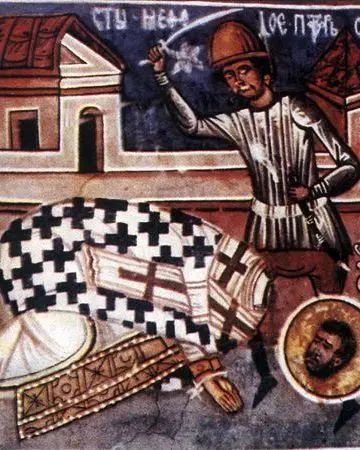
Saint Methodius of Olympus
Early bishop and writer, critic of Origen, probably martyred around 311
- Rank
- Saint
- Kind
- Bishop, Martyr
- Life
- d. ~311
- Era
- 4th century
- Countries
- Türkiye
Life story
Very little reliable information survives about Methodius. Eusebius does not mention him in his Church History, and the earliest source is Jerome. According to Jerome he was bishop of Olympus in Lycia and later of Tyre, but the Catholic Encyclopedia regards the Tyre episcopate as unreliable. His year of birth is unknown.
He had a wide education, was strongly shaped by Plato and used allegorical interpretation of Scripture. His only work preserved complete in Greek is the Symposium, a dialogue in which ten virgins praise virginity and which ends with a hymn to Christ. Large Greek portions of On Free Will and On the Resurrection also survive, the latter arguing against Origen on the resurrection of the body. Some Slavonic versions of shorter works exist, while his treatise against Porphyry and his commentaries on Genesis and the Song of Songs are lost.
Jerome places his death at the end of the last persecution under Maximinus Daza, about 311, and mentions another account that he was martyred at Chalcis under Decius and Valerian; scholars do not accept the latter. Several later works, such as the seventh-century Apocalypse of Pseudo-Methodius, were wrongly attributed to him. Because the evidence is so limited, many details of his life are best treated as conjecture.
Works and witness
- Bishop, according to Jerome of Olympus in Lycia
- Author of the dialogue Symposium on virginity
- Criticised Origen's teaching on the resurrection of the body
- Probably died a martyr around 311
- Several later works were wrongly attributed to him
Saints from the same country
References
- Catholic Encyclopedia (New Advent): 'St. Methodius of Olympus'
- Jerome, De Viris Illustribus (via New Advent, as cited by search summary)
- Wikipedia article on Methodius of Olympus (read in full; see, death, works, misattributions)
Written by Anawim from documented history. Some details about ancient saints rest on tradition and are marked as such.