

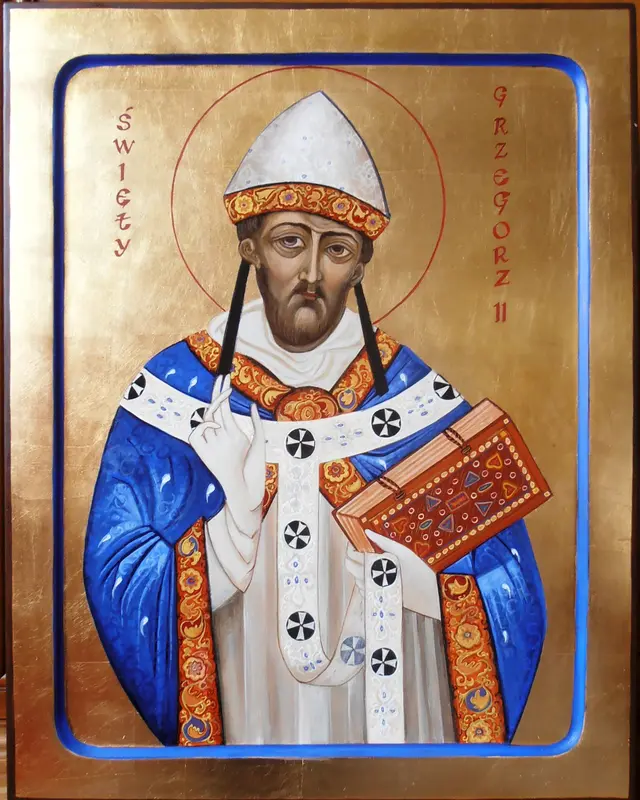
Pope Saint Gregory II
The pope who sent Boniface to Germany and resisted the emperor's ban on images
- Rank
- Saint
- Kind
- Pope
- Life
- d. 731
- Era
- 8th century
- Feast
- 11 February
- Countries
- Italy
Life story
Gregory II was born in Rome, the son of Marcellus and Honesta; the year of his birth is not known. As a boy he was placed in the papal choir school, and under Pope Sergius I he became a subdeacon and the official in charge of the Church's finances and alms. He also accompanied Pope Constantine to Constantinople to discuss the canons of the Quinisext Council with Emperor Justinian II.
He became pope on 19 May 715. Soon after he began repairing the walls of Rome, though a flood of the Tiber left the work unfinished. He welcomed Anglo-Saxon pilgrims and Duke Theodo I of Bavaria, sent Corbinian to Bavaria, and commissioned Winfrid, later known as Boniface, to preach in Germany; he consecrated Boniface a bishop in 722. He helped restore the abbey of Monte Cassino and, after his mother died, turned his family home into a monastery.
Relations with Constantinople grew tense under Emperor Leo III. Gregory objected to taxes he thought unjust and to the emperor's interference in doctrine. When the emperor issued decrees against holy images, Gregory opposed them, and in 727 a council in Rome affirmed the Church's teaching on honouring images. Gregory died in February 731 and was buried in St. Peter's on 11 February 731.
Works and witness
- Elected on 19 May 715 and began repairing Rome's walls
- Commissioned Boniface in 719 and consecrated him a bishop in 722
- Helped restore the abbey of Monte Cassino
- Opposed Emperor Leo III's ban on holy images; Roman council of 727
- Welcomed Anglo-Saxon visitors such as Abbot Ceolfrid and King Ina
Saints from the same country
References
- New Advent, Catholic Encyclopedia (1909), 'Pope St. Gregory II', newadvent.org/cathen/06787a.htm
Written by Anawim from documented history. Some details about ancient saints rest on tradition and are marked as such.