

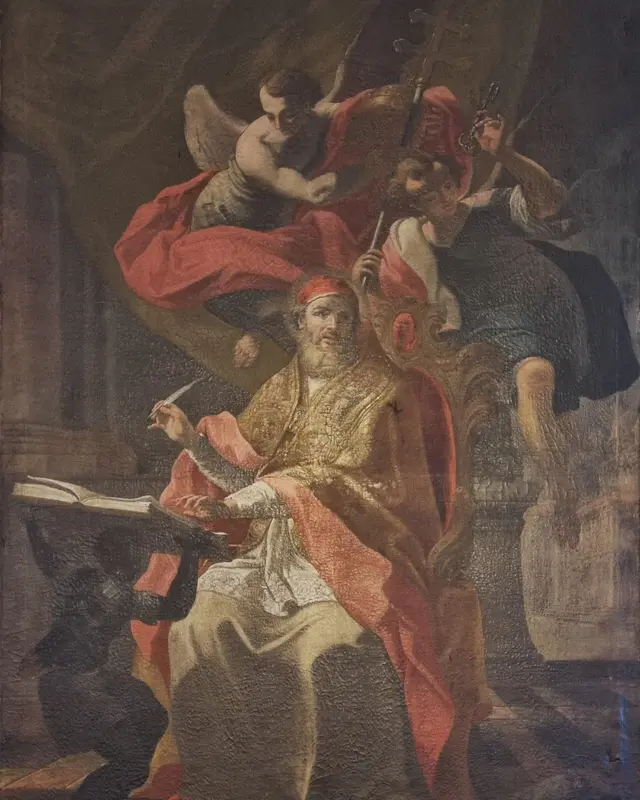
Pope Saint Gelasius I
Pope of African descent who wrote Duo sunt on the two powers and ended the Lupercalia
- Rank
- Saint
- Kind
- Pope
- Life
- d. 496
- Era
- 5th century
- Feast
- 21 November
- Countries
- Italy
Life story
The Liber Pontificalis calls Gelasius African by origin, yet in a letter to Emperor Anastasius he called himself Roman by birth; the Catholic Encyclopedia notes that scholars read the two statements differently. He was bishop of Rome from 1 March 492 until his death on 19 November 496; some writers give 21 November, the day of his burial.
His pontificate was dominated by the Acacian schism between Rome and Constantinople. He insisted that the name of Patriarch Acacius be removed from the diptychs read in the liturgy, and he argued for the primacy of the see of Rome. In 494 he wrote the letter Duo sunt to Emperor Anastasius, discussing the relation of church and political authority; it remained influential for over a thousand years.
He also suppressed the Lupercalia, an ancient Roman festival that still persisted among a nominally Christian population, after a long dispute; his letter to the senator Andromachus deals with the matter. Several works carry his name without being fully his. The Gelasian Decree, which lists books of Scripture and forbidden writings, is judged by scholars to be later, and the Gelasian Sacramentary was compiled in the mid-eighth century, though it may contain some prayers of his. He enforced a fourfold division of church revenues, and he died with little, having given lavishly to the poor. His feast is 21 November, the anniversary of his burial.
Works and witness
- Pope from 1 March 492 until his death on 19 November 496
- Held a firm line in the Acacian schism
- Wrote the letter Duo sunt to Emperor Anastasius in 494 on the two powers
- Suppressed the Lupercalia festival in Rome
- The Gelasian Decree and Sacramentary bear his name but are not wholly his work
Saints from the same country
References
- Catholic Encyclopedia (New Advent), 'Pope St. Gelasius I', 1909
Written by Anawim from documented history. Some details about ancient saints rest on tradition and are marked as such.