

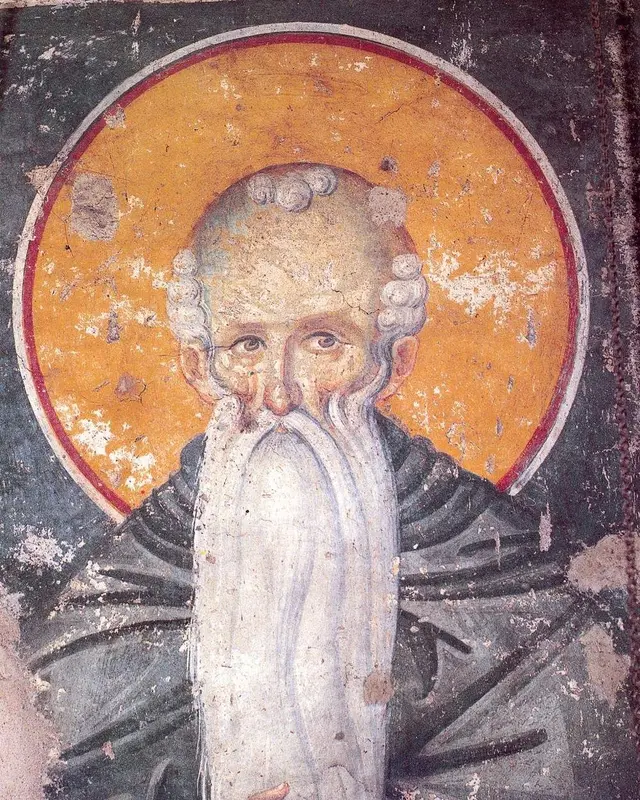
Saint Euthymius the Great
Armenian monk who founded communities in the Judaean desert and shaped Palestinian monasticism
- Rank
- Saint
- Kind
- Religious, Founder
- Life
- ~377 – 473
- Era
- 5th century
- Feast
- 20 January
- Countries
- Türkiye, Palestinian Territories
Life story
He was born in 377 at Melitene in Lesser Armenia (modern Malatya, Turkey), into a noble Christian family. Bishop Otreius of Melitene educated him, ordained him and put him in charge of the diocese's monasteries. Around 405–406 he travelled quietly to Jerusalem and spent five years in a cave cell near the Pharan monastery in Wadi Kelt.
In 411, with the hermit Theoctistus, he founded a monastery on the bank of a torrent, regarded as the first community monastery in the Judaean desert. In 421 he left it in Theoctistus's care and founded other settlements, including the laura that bears his name; its church was consecrated by Archbishop Juvenal of Jerusalem on 7 May 428. A Bedouin chief he baptised, Aspebetus (Peter), later became a priest and then a bishop.
At the Council of Chalcedon (451) he sided with the Chalcedonian party. When the Monophysite party took over the see of Jerusalem he withdrew to the desert, returning in 453. Around 457 Saint Sabas was sent to Theoctistus's monastery shortly after arriving in Palestine. Euthymius died on 20 January 473 and was buried in his monastery. His life was written by Cyril of Scythopolis.
Works and witness
- Ordained by Bishop Otreius and put in charge of Melitene's monasteries
- Went to Jerusalem around 405–406 and lived in a cave near Pharan
- Founded with Theoctistus the first community monastery in the Judaean desert in 411
- Founded the laura named for him; church consecrated 7 May 428
- Supported the Chalcedonian side and died on 20 January 473
Saints from the same country
References
- Britannica, "Saint Euthymius the Great"
- Encyclopedia.com, "Euthymius the Great, St."
- Cyril of Scythopolis, Life of Euthymius (Lives of the Monks of Palestine)
Written by Anawim from documented history. Some details about ancient saints rest on tradition and are marked as such.