

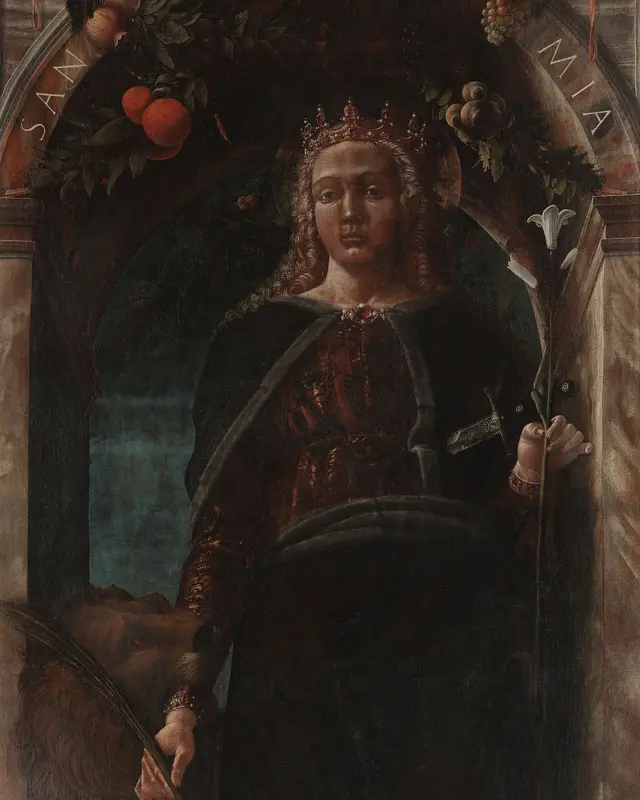
Saint Euphemia of Chalcedon
Martyr of Chalcedon, in whose church the Council of 451 met
- Rank
- Saint
- Kind
- Martyr, Virgin
- Feast
- 16 September
- Countries
- Türkiye
Life story
Very little about Euphemia's life is certain. The early sources show only that she was a martyr at Chalcedon (modern Kadıköy, Istanbul); the Orthodox Church in America gives 304 and others 303, during the persecution of Diocletian; the Catholic Encyclopedia suggests it may have been under Galerius (305–311). The fifth-century Martyrologium Hieronymianum records her name and date, and the pilgrim Egeria, who travelled in this region around 381–384, wrote that she was shown the site of her martyrdom.
The firmest evidence of devotion to her is the Council of Chalcedon of 451, which met in the church that housed her relics. A letter of the council to Pope Leo I, according to an Orthodox source, speaks of “the triumphant Euphemia who crowned the meeting”. Around 620, after the Persian conquest of Chalcedon in 617, her relics were moved to Constantinople. Most of them are now kept in the Patriarchal Church of St George in Istanbul.
Most of the story usually told is legend without contemporary sources: that she was born in Chalcedon, tortured by the governor Priscus with the wheel, fire and wild beasts, and tended by an angel. Another legend, found only in the eleventh-century Synaxarion, says that at the 451 council two confessions of faith were placed in her tomb and the Chalcedonian one was found in her hand; Oriental Orthodox churches dispute this. Her feast is 16 September, and the Orthodox also commemorate her on 11 July.
Works and witness
- Martyred at Chalcedon in the fourth-century persecution (303 or 304)
- The Council of Chalcedon met in her church in 451
- Her relics were moved to Constantinople around 620
- Commemorated on 16 September
Saints from the same country
References
- Orthodox Church in America, “Great Martyr Euphemia the All-praised” (oca.org, 16 September) – Chalcedon 304, Priscus, Council of 451, relics to Constantinople c. 620, feasts 16 September and 11 July
- Catholic Encyclopedia (New Advent), “Chalcedon” (cathen/03554a) – the Council met in her church; death probably under Galerius
- Wikipedia (English), “Euphemia” – Martyrologium Hieronymianum, Egeria, Synaxarion legend
Written by Anawim from documented history. Some details about ancient saints rest on tradition and are marked as such.