

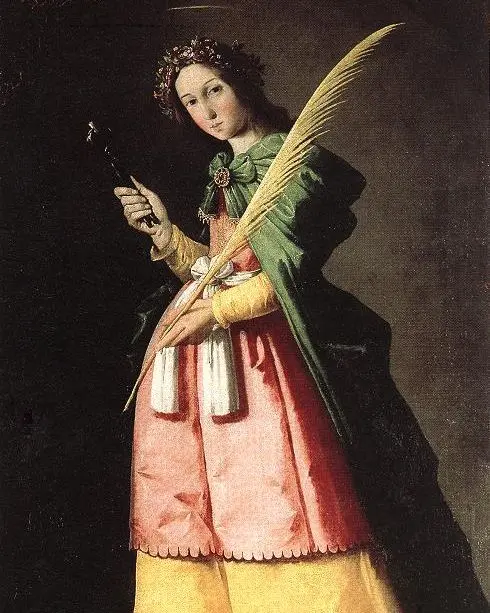
Saint Apollonia
Christian woman killed by a mob in Alexandria, around 249
- Rank
- Saint
- Kind
- Martyr, Virgin
- Life
- d. ~249
- Era
- 3rd century
- Feast
- 9 February
- Countries
- Egypt
Life story
Very little about Apollonia is certain. The oldest source is a letter of Dionysius, bishop of Alexandria (about 247 to 265), to Fabius of Antioch; a long extract is preserved by Eusebius in his Ecclesiastical History.
According to that letter, before the official persecution under Decius, a mob uprising against Christians broke out in Alexandria, in the last years of the emperor Philip the Arab (244 to 249). Apollonia had her teeth broken, and was then threatened with burning if she would not speak impious words. According to the letter she asked for a moment's freedom and then threw herself into the fire. Dionysius calls her an aged virgin or elder (presbytera); the Catholic Encyclopedia reads this as probably meaning a deaconess.
The Golden Legend of Jacobus de Voragine (about 1260) later expanded this short account and added moral reflection. Some later versions also speak of a Christian virgin of Rome in the time of Julian; scholars regard this as a mistaken duplication.
Because her teeth were broken, she came to be invoked against toothache, and she is usually shown holding pincers gripping a tooth. Many places claim relics of her, but the medieval objects sold as her teeth are of doubtful authenticity. Her feast is 9 February.
Works and witness
- Tortured and killed by a mob in Alexandria, around 249
- Recorded in the letter of Bishop Dionysius, preserved by Eusebius
- Invoked against toothache
Patron of
Dentists, People with toothache
Saints from the same country
References
- Eusebius, Ecclesiastical History 6.41 (quoting Dionysius of Alexandria)
- Catholic Encyclopedia, "St. Apollonia" (newadvent.org/cathen/01617c.htm)
Written by Anawim from documented history. Some details about ancient saints rest on tradition and are marked as such.