

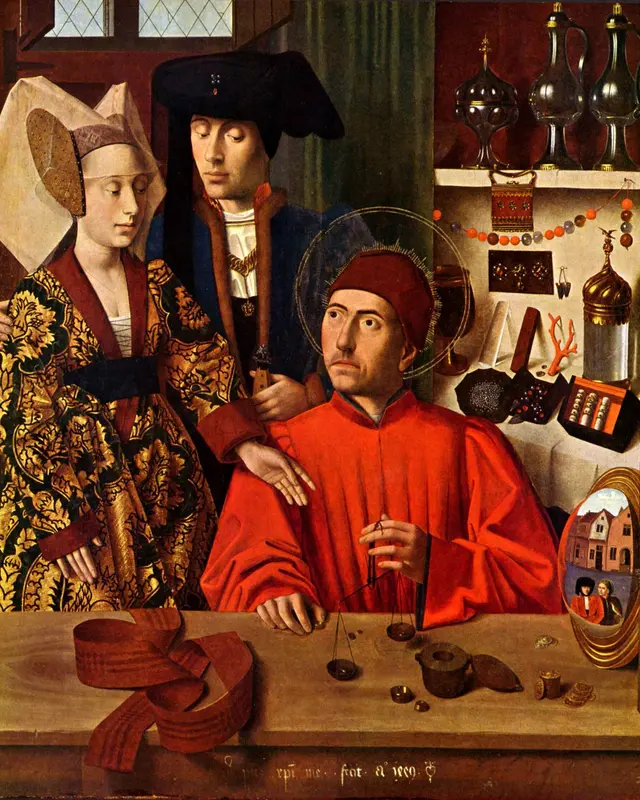
Saint Eligius
Goldsmith of the Frankish court who became bishop of Noyon
- Rank
- Saint
- Kind
- Bishop
- Life
- 588 – 660
- Era
- 7th century
- Feast
- 1 December
- Countries
- France
Life story
Eligius was born around 588 to 590 at Chaptelat, near Limoges, into a Gallo-Roman family. He trained as a goldsmith at Limoges, worked at the Frankish court under King Clotaire II, and later served as master of the mint at Marseille.
Under King Dagobert I (629 to 639) he became a close adviser. He helped arrange a pact between Dagobert and Judicael, used his influence to ransom captives and aid the poor, and founded the monastery of Solignac in 631 or 632. After Dagobert's death in 639 he left the court and entered the priesthood.
In 640 or 641, after Bishop Acarius died, he succeeded him as bishop of Noyon–Tournai and held the see until his death. He worked to convert the pagan populations of Flanders and founded churches and monasteries. Some of his sermons and a letter of 645 survive.
He died on 1 December 660 at Noyon and was buried there. His friend Audoin, bishop of Rouen, wrote the Vita Sancti Eligii, the main source for his life, though it is partly hagiographic. The famous story of his cutting off and refitting a horse's leg in order to shoe it is a legend.
Works and witness
- Goldsmith at the Frankish court and master of the mint at Marseille
- Adviser to Dagobert I, helped ransom captives
- Founded the monastery of Solignac in 631 or 632
- Became a priest after the death of Dagobert in 639
- Bishop of Noyon–Tournai from 640 or 641 until 660
Patron of
Goldsmiths, Metalworkers, Horses
Saints from the same country
References
- Catholic Encyclopedia, "St. Eligius" (newadvent.org/cathen/05386a.htm)
Written by Anawim from documented history. Some details about ancient saints rest on tradition and are marked as such.