

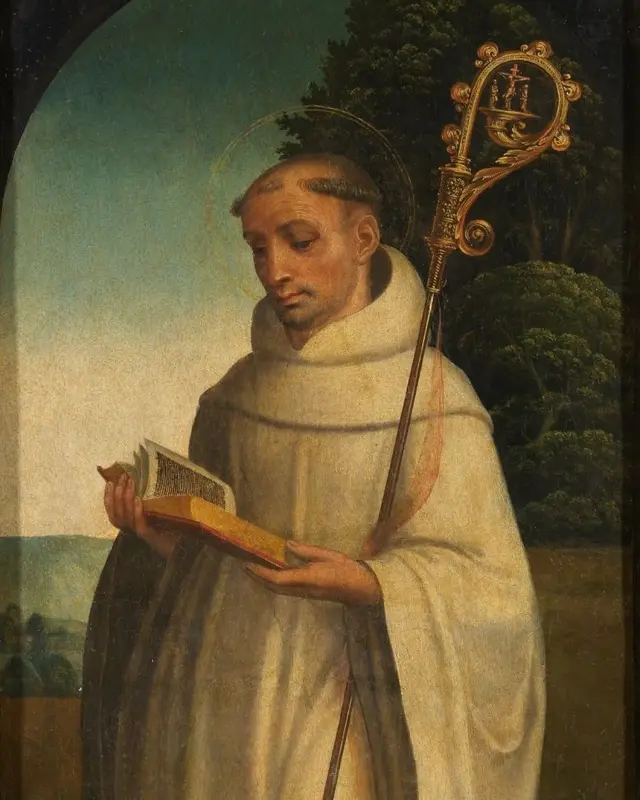
Saint Bernard of Clairvaux
Abbot of Clairvaux, the most influential preacher and writer of the twelfth century
- Rank
- Saint
- Kind
- Religious, Doctor of the Church
- Life
- 1090 – 1153
- Era
- 12th century
- Feast
- 20 August
- Countries
- France
Life story
Bernard was born around 1090 at Fontaine-lès-Dijon in Burgundy, into a family of knights. Around 1112 he entered the abbey of Cîteaux together with some thirty relatives and friends. Three years later he was sent to found a new abbey at Clairvaux and remained its abbot for the rest of his life. From Clairvaux the Cistercian order opened many more houses across Europe.
Although he lived as a monk, Bernard was often called out to serve the wider Church. He supported Innocent II in the disputed papal election of 1130 and took part in the theological controversies of the day, including the challenge to Abelard at the council of Sens in 1141. In 1146, at the request of Pope Eugene III, a former Clairvaux monk, he preached the Second Crusade, a campaign that ended in failure.
He left many sermons, letters and treatises. The best known are his series of sermons on the Song of Songs, his treatise On Loving God, and De consideratione, written for Eugene III about the duties of the man who leads the Church. Later generations regarded his Latin style as a model.
Bernard died at Clairvaux on 20 August 1153. He was canonised in 1174 and declared a Doctor of the Church by Pius VIII in 1830. He is still remembered as a reformer of monastic life and a major writer of the Middle Ages.
Works and witness
- Entered Cîteaux in 1112 and founded Clairvaux in 1115
- Supported Innocent II in the disputed election of 1130
- Preached the Second Crusade in 1146
- Wrote the Song of Songs sermons and De consideratione
- Declared a Doctor of the Church in 1830
Saints from the same country
References
- Martyrologium Romanum
- Bernard of Clairvaux, Sermones super Cantica Canticorum
- Bernard of Clairvaux, De consideratione
Written by Anawim from documented history. Some details about ancient saints rest on tradition and are marked as such.