

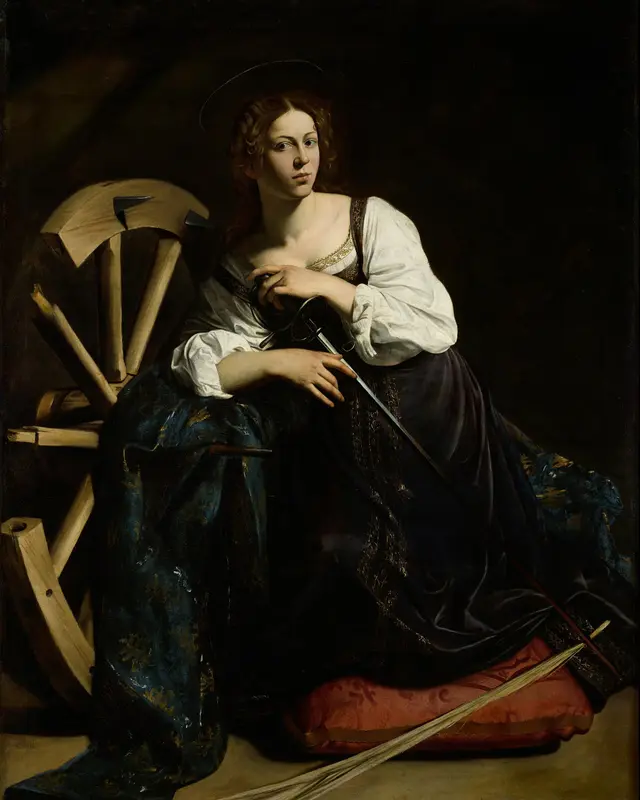
Saint Catherine of Alexandria
The martyr of Alexandrian legend, deeply loved across the Middle Ages
- Rank
- Saint
- Kind
- Martyr, Virgin
- Feast
- 25 November
- Countries
- Egypt
Life story
Reliable early sources say almost nothing about Saint Catherine of Alexandria. The best-known account comes from Passion texts written centuries after the period she is said to have lived, so it is largely legendary. Historians today are therefore cautious about whether she existed and when. According to the legend, she was a young woman of noble family in Alexandria, deeply educated, living in the early fourth century.
The legend says she debated scholars summoned by the emperor, won them over to Christianity, and denounced the persecution. She was imprisoned and tortured on a spiked wheel, which broke apart, and was then beheaded. The wheel became her emblem in art, and her name was later attached to a firework known as the Catherine wheel. All these details should be read as legend.
The legend adds that angels carried her body to Mount Sinai. The famous monastery at the foot of Sinai later took her name, and veneration of her relics there is recorded only many centuries afterwards. Devotion to her spread across medieval Europe, and many churches were dedicated to her. Joan of Arc said she heard the voice of Saint Catherine. In 1969 her name was removed from the universal liturgical calendar because of the lack of historical certainty, and her feast on 25 November was later restored as optional. Her story was retold in many languages and illustrated in medieval manuscripts, stained glass and panel paintings, which kept her popular long after the sources for her life were questioned.
Works and witness
- By legend, a learned young woman of Alexandria put to death for her faith
- Legend says she out-argued scholars before the emperor
- The spiked wheel became her emblem in Christian art
- The monastery at the foot of Mount Sinai bears her name and keeps relics linked to her
- Widely honoured in medieval Europe; feast on 25 November
Saints from the same country
References
- Passio of Saint Catherine of Alexandria (medieval Passion texts)
- Martyrologium Romanum
- Dicastery for the Causes of Saints – biographical profile
Written by Anawim from documented history. Some details about ancient saints rest on tradition and are marked as such.