

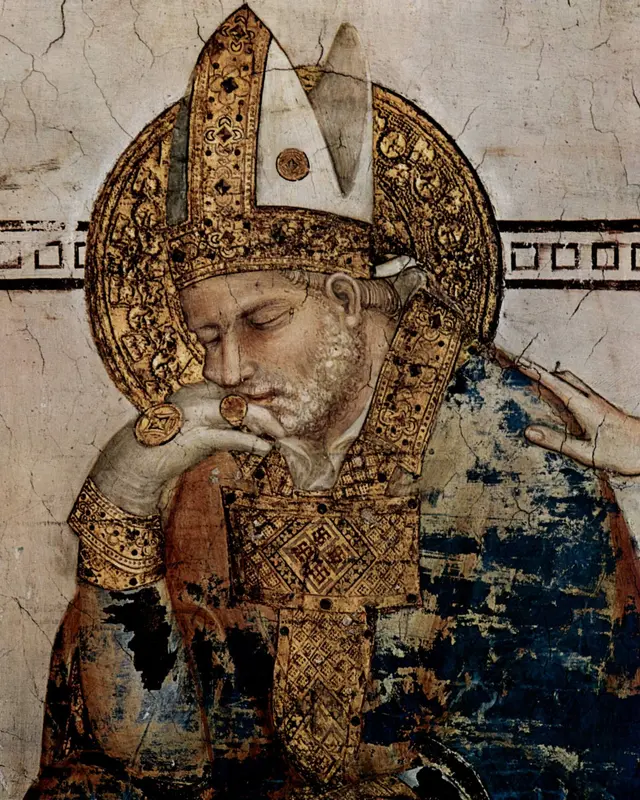
Saint Martin of Tours
A soldier from Pannonia who became a monk and then bishop of Tours
- Rank
- Saint
- Kind
- Bishop
- Life
- ~316 – ~397
- Era
- 4th century
- Feast
- 11 November
- Countries
- Hungary, France
Life story
Martin was born around 316 at Savaria in the province of Pannonia, today Szombathely in Hungary, and grew up in Pavia, Italy. His father was a Roman army officer, and Martin had to join the army at fifteen. As a boy he had already asked to be enrolled as a catechumen. Sulpicius Severus, who wrote his biography while Martin was still alive, tells how at Amiens in midwinter he cut his cloak in two to cover a beggar. This is a story told by a hagiographer, and it became the best-known image of him.
After leaving the army around 356, Martin went to Poitiers to study with Bishop Hilary. He lived in several places for a time and then founded a monastic community at Ligugé, often regarded as one of the first monasteries in Gaul. Around 371 the people of Tours chose him as their bishop. According to Sulpicius, he kept living simply in a hut near the city and then founded the monastery of Marmoutier on the Loire.
Martin travelled widely through the Gaulish countryside, where most people still followed pagan religion, and had many churches built. He died on 8 November 397 at Candes and was buried at Tours on 11 November, the day now kept as his feast. His tomb became a major pilgrimage site in medieval Europe. Sulpicius Severus wrote the Life of Martin, which made him widely known across the Western Church.
Works and witness
- Born at Savaria (Pannonia), enlisted at fifteen following his father's military career
- According to Sulpicius Severus, shared his cloak with a beggar at Amiens
- Studied under Bishop Hilary at Poitiers and founded a monastery at Ligugé
- Became bishop of Tours around 371 and founded the monastery of Marmoutier
- Preached in rural Gaul; his tomb at Tours was a major medieval pilgrimage site
Saints from the same country
References
- Sulpicius Severus, Vita Martini
- Gregory of Tours, Historia Francorum
- Martyrologium Romanum
Written by Anawim from documented history. Some details about ancient saints rest on tradition and are marked as such.