

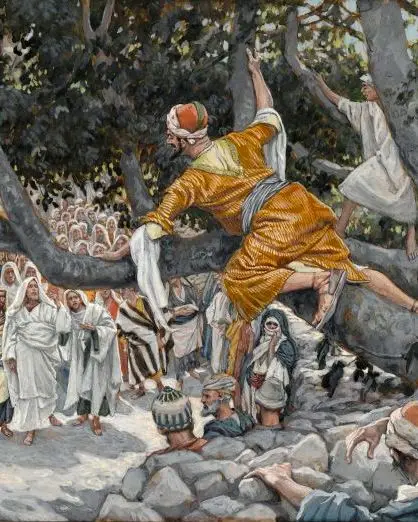
Saint Zacchaeus
The short tax collector of Jericho who climbed a sycamore to see Jesus
- Rank
- Saint
- Kind
- Layperson, Biblical figure
- Countries
- Israel
Life story
The Gospel of Luke, chapter 19, tells how Jesus was passing through Jericho on his way up to Jerusalem. A man named Zacchaeus, a chief tax collector and a rich man, wanted to see who Jesus was but, being short and blocked by the crowd, ran ahead and climbed a sycamore-fig tree. Jesus stopped, called him down, and said he would stay at his house that day. Zacchaeus hurried down and welcomed him gladly, while many people muttered that Jesus had gone to be the guest of a sinner.
Before everyone, Zacchaeus declared that he would give half his possessions to the poor and, if he had cheated anyone, repay four times as much. Luke records Jesus saying that salvation had come to that house, since Zacchaeus too was a son of Abraham. That is all Scripture says; no passage reports that he followed Jesus or what he did afterward.
The rest is tradition. The Apostolic Constitutions (book 7) call him the first bishop of Caesarea in Palestine, and the Clementine Recognitions, a work of uncertain historical value, say Peter appointed him bishop there. The Eastern churches keep his feast on 20 April. In France, a medieval legend identified him with the hermit Amadour of Rocamadour, but there is no historical basis for this. He should not be confused with Zacchaeus, a later bishop of Jerusalem, whom the Roman Martyrology marks on 23 August.
Works and witness
- Wealthy chief tax collector in Jericho (Luke 19)
- Climbed a sycamore-fig tree to see Jesus pass by
- Welcomed Jesus into his house and pledged half his goods to the poor
- Promised fourfold repayment to anyone he had cheated
- By tradition, first bishop of Caesarea in Palestine
Saints from the same country
References
- Gospel according to Luke
- Apostolic Constitutions
- Martyrologium Romanum
Written by Anawim from documented history. Some details about ancient saints rest on tradition and are marked as such.