

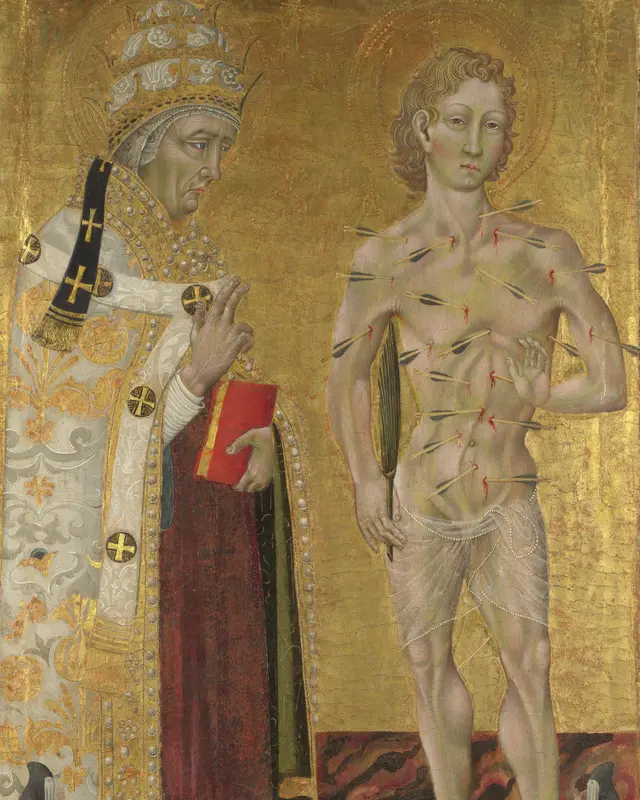
Pope Saint Fabian
Pope from 236 to 250, who died at the start of Decius's persecution
- Rank
- Saint
- Kind
- Pope, Martyr
- Life
- d. ~250
- Era
- 3rd century
- Feast
- 20 January
- Countries
- Italy
Life story
According to the historian Eusebius, Fabian came to Rome from the countryside and none of the electors had him in mind. During thirteen days of deliberation a dove alighted on his head, and the assembly took this as a sign and acclaimed him. He was bishop of Rome from 10 January 236, succeeding Anterus, until his death on 20 January 250; Cornelius followed him.
His roughly fourteen-year pontificate was mostly peaceful. He had the bodies of Pontian and Hippolytus brought back from Sardinia, where both had died in the mines. According to the Liber Pontificalis, he divided Rome's Christian communities into seven districts, each overseen by a deacon, and appointed seven subdeacons to collect the court records of the martyrs. According to Gregory of Tours, around 245 he sent seven missionaries to Gaul. The claim that he baptised Emperor Philip the Arab is considered probably legendary.
He died on 20 January 250 at the start of the Decian persecution, probably in prison rather than by execution. He was buried in the Catacomb of Callixtus, where a Greek inscription reads “Fabian, bishop, martyr”. His remains were later moved to San Sebastiano fuori le mura. Cyprian called him “incomparable” in a letter to Cornelius.
Works and witness
- Elected bishop of Rome in 236; Eusebius tells of the dove
- Brought the bodies of Pontian and Hippolytus back from Sardinia
- Divided Rome into seven districts, each under a deacon
- According to Gregory of Tours, sent seven missionaries to Gaul around 245
- Died on 20 January 250 at the start of Decius's persecution
Saints from the same country
References
- Eusebius, Ecclesiastical History 6.29 (dove account, as reported by Eusebius)
- Cyprian, Letter 9 (as cited in secondary summaries)
- PopeHistory.com, "Pope St. Fabian"
Written by Anawim from documented history. Some details about ancient saints rest on tradition and are marked as such.