

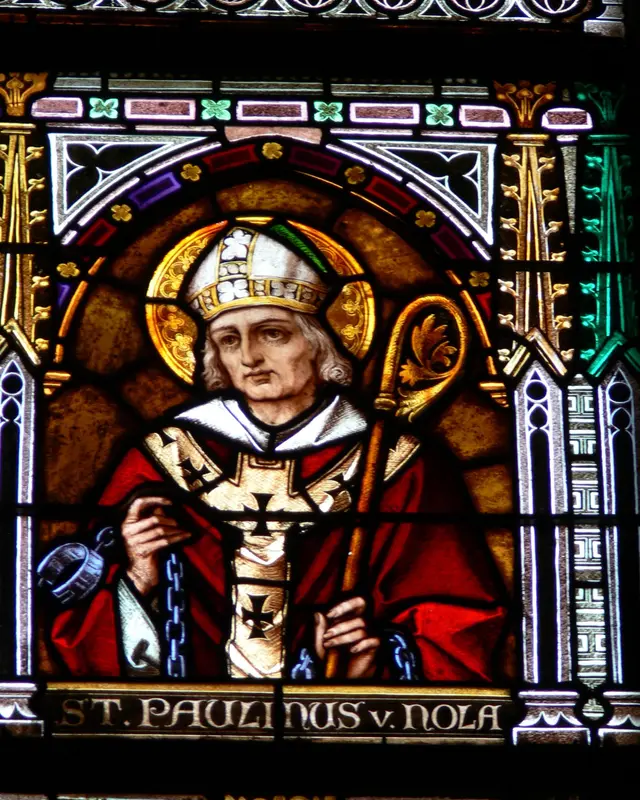
Saint Paulinus of Nola
A wealthy Gaulish senator who gave up office to become bishop of Nola and a poet
- Rank
- Saint
- Kind
- Bishop
- Life
- ~354 – 431
- Era
- 5th century
- Feast
- 22 June
- Countries
- Italy, France
Life story
Paulinus was born around 354 at Bordeaux into a noble family with large estates in Gaul and Spain. He studied literature under the poet Ausonius, became a Roman senator and around 380 governor of Campania, where he came to know the shrine of Saint Felix at Nola. He later married Therasia, a woman of Spain, and the couple had a son who died when very young.
Around 390 he was baptised, and in 394 or 395 he was ordained a priest at Barcelona at the demand of the people. He and his wife sold much of their property to help the poor, which surprised friends and family. In 395 he settled at Nola, near the tomb of Felix, and lived there as a man of religious life.
At Nola, Paulinus enlarged the shrine, added further churches and built a hospital for poor people. Every year on the feast of Felix he composed a poem in his honour, and these form an important part of his surviving verse. He corresponded with Augustine, Jerome, Ausonius and many others, and the letters help show the intellectual life of Christians of the time.
Around 409 or 410 he was chosen bishop of Nola and governed the diocese until his death on 22 June 431, which is also his day of remembrance. A popular story says he sold himself into slavery to ransom a widow's son, but it is a later tradition and does not appear in contemporary sources.
Works and witness
- Born at Bordeaux, governor of Campania around 380
- Sold much of his property with his wife to help the poor
- Settled at Nola from 395 and enlarged the shrine of Felix
- Wrote a poem for Felix's feast each year
- Bishop of Nola from about 409, died in 431
Saints from the same country
References
- Paulinus of Nola, Carmina and Epistulae
- Martyrologium Romanum
- Catholic Encyclopedia (New Advent) – St. Paulinus of Nola
Written by Anawim from documented history. Some details about ancient saints rest on tradition and are marked as such.