

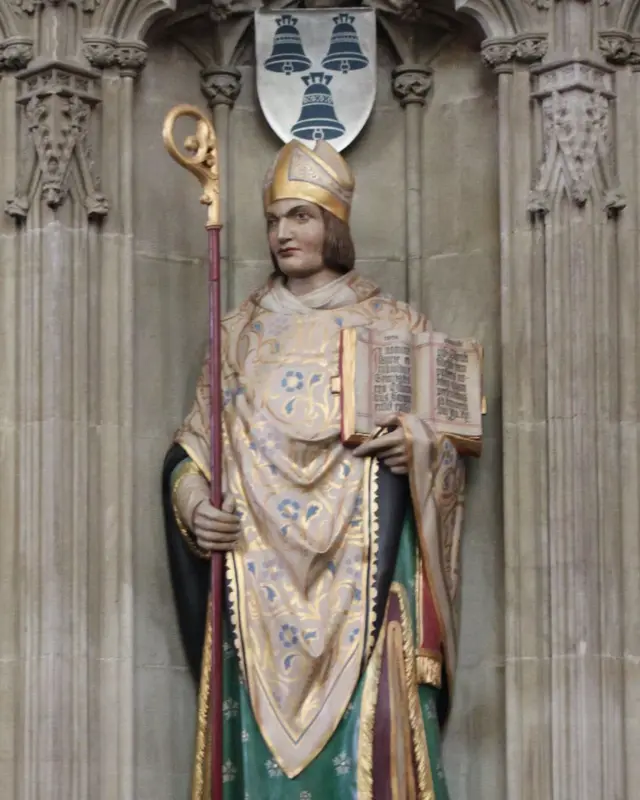
Saint Osmund
Norman bishop of Salisbury, organiser of the Sarum liturgy and builder of Old Sarum
- Rank
- Saint
- Kind
- Bishop
- Life
- d. 1099
- Era
- 11th century
- Feast
- 4 December
- Countries
- France, United Kingdom
Life story
Osmund was a Norman noble who came to England with Duke William of Normandy. He served as chancellor of England before his appointment as bishop. In 1078 he was appointed bishop of Salisbury and consecrated by Archbishop Lanfranc. His diocese covered Dorset, Wiltshire and Berkshire. In 1086 he was present at the great assembly at Old Sarum when the Domesday Book was accepted.
He built the cathedral at Old Sarum, consecrated on 5 April 1092. He organised a chapter of secular canons and a school for clergy beside it, a model that other cathedrals copied. He also arranged the service books, based on the Roman rite, that later became known as the Sarum Use. The Catholic Encyclopedia notes that he introduced little that was new, yet these books spread widely through England, Wales and Ireland, reaching Scotland around 1250.
He died on 3 December 1099, and the see stood vacant for eight years before Roger of Salisbury succeeded him. Canonisation proceedings began in 1228, but Pope Callixtus III issued the bull only on 1 January 1457. His remains were moved to New Salisbury on 23 July 1457. His shrine was destroyed under Henry VIII. His feast is 4 December.
Works and witness
- Chancellor of England until 1078, then bishop of Salisbury from 1078
- Present at the Old Sarum assembly of 1086 when Domesday Book was accepted
- Dedicated Old Sarum cathedral on 5 April 1092
- Organised a cathedral chapter and the service books later called the Sarum Use
- Canonised on 1 January 1457
Saints from the same country
References
- Catholic Encyclopedia (New Advent), 'St. Osmund', 1911
Written by Anawim from documented history. Some details about ancient saints rest on tradition and are marked as such.