

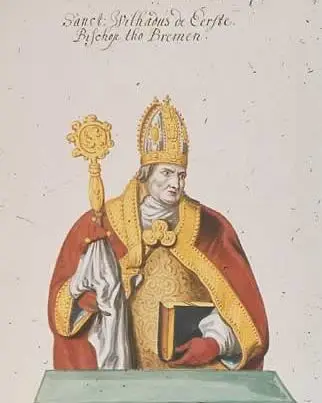
Saint Willehad
Northumbrian missionary and first bishop of Bremen who survived the Saxon uprising
- Rank
- Saint
- Kind
- Bishop, Missionary
- Life
- d. 789
- Era
- 8th century
- Feast
- 8 November
- Countries
- United Kingdom, Germany
Life story
Willehad was born in Northumbria before 745 and probably studied at York under Egbert. He was a friend of Alcuin. With King Alchred's permission he was sent to Frisia sometime between 765 and 774. He made converts at Dokkum, where Boniface had been killed, then moved to Drenthe, where progress was slow at first and then stalled.
In 780 Charlemagne sent him to Wigmodia, between the Weser and the Elbe. The work went well and he built many churches. Widukind's uprising of 782 destroyed the churches and killed many of his companions. He fled to Frisia and then to Rome, where Pope Adrian I received him. He then stayed at the abbey of Echternach and copied books, among them the Pauline epistles.
After the revolt was suppressed he returned to Wigmodia. On 13 July 787 he was consecrated bishop at Worms and made Bremen his seat. The cathedral of Bremen, dedicated to St Peter, was consecrated on 1 November 789. A few days later he fell ill with a fever on a missionary tour and died on 8 November 789 at Blexen on the Weser. The Catholic Encyclopedia notes that the diocese of Bremen was formally erected only under his successor Willerich. His life was written by a Bremen cleric after 838, and Anskar wrote an account of the miracles. The Catholic Encyclopedia gives his feast as 13 July, the day of his consecration, revived in 1901 for several German dioceses.
Works and witness
- Missionary in Frisia between about 765 and 774
- Sent by Charlemagne to Wigmodia in 780
- Fled Widukind's revolt in 782, going to Rome and Echternach
- Consecrated bishop at Worms on 13 July 787
- Dedicated Bremen cathedral on 1 November 789; died on 8 November
Saints from the same country
References
- Catholic Encyclopedia (New Advent), 'St. Willehad', 1912
Written by Anawim from documented history. Some details about ancient saints rest on tradition and are marked as such.