

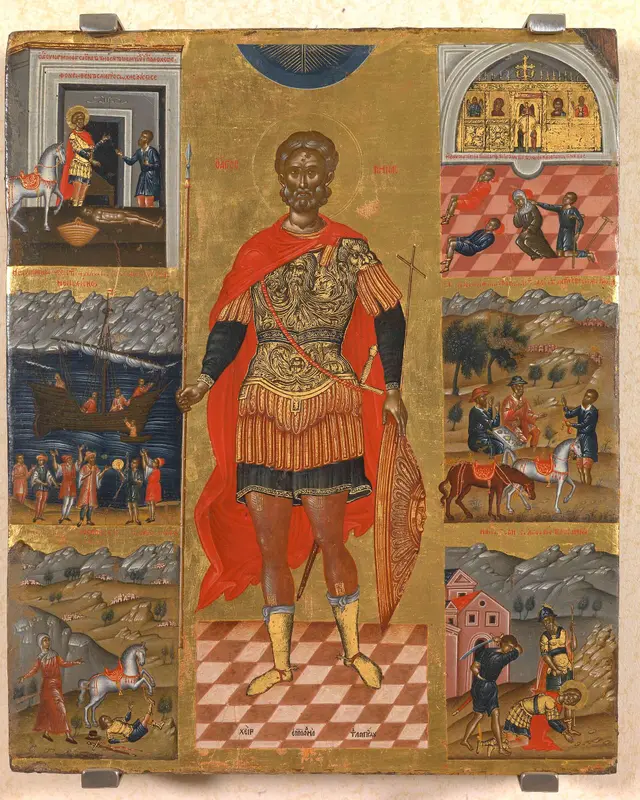
Saint Menas of Egypt
Soldier-martyr whose tomb became the pilgrimage centre of Abu Mena near Alexandria
- Rank
- Saint
- Kind
- Martyr
- Life
- ~285 – ~309
- Era
- 4th century
- Feast
- 11 November
- Countries
- Egypt, Türkiye
Life story
Very little about Menas is certain. According to tradition he was an Egyptian, born around 285, who served in the Roman army; many sources place him at Cotyaeum in Phrygia, now in Turkey. After three years he left the army, lived as a hermit, then openly declared himself a Christian and was martyred around 309 during the persecution of the emperor Diocletian; some sources place his death around 296.
Accounts of his remains differ. In one tradition his sister bribed the soldiers and took his body to Alexandria; later, legend says, a camel carrying it stopped near Lake Mariout west of Alexandria and would not move on, and he was buried at that spot. These stories, together with the tale of the shepherd, are legendary and exist in several versions.
The site grew into Abu Mena, a large pilgrimage town with churches, baths and hostels. Pilgrims took home small clay flasks stamped with his image, recognisable by a figure standing between two camels; the flasks have been found across the Mediterranean and beyond. The Abu Mena archaeological site was inscribed on the UNESCO World Heritage List in 1979. His memorial is 11 November.
Works and witness
- Roman soldier and martyr, traditionally around 309
- His tomb became the major pilgrimage site of Abu Mena
- Clay flasks with his image have been found across the Mediterranean
- Abu Mena is a UNESCO World Heritage site
- Memorial on 11 November
Saints from the same country
References
- Martyrologium Romanum
- Synaxarion of the Coptic Church
- Archaeological record of Abu Mena (UNESCO World Heritage listing, 1979)
Written by Anawim from documented history. Some details about ancient saints rest on tradition and are marked as such.