

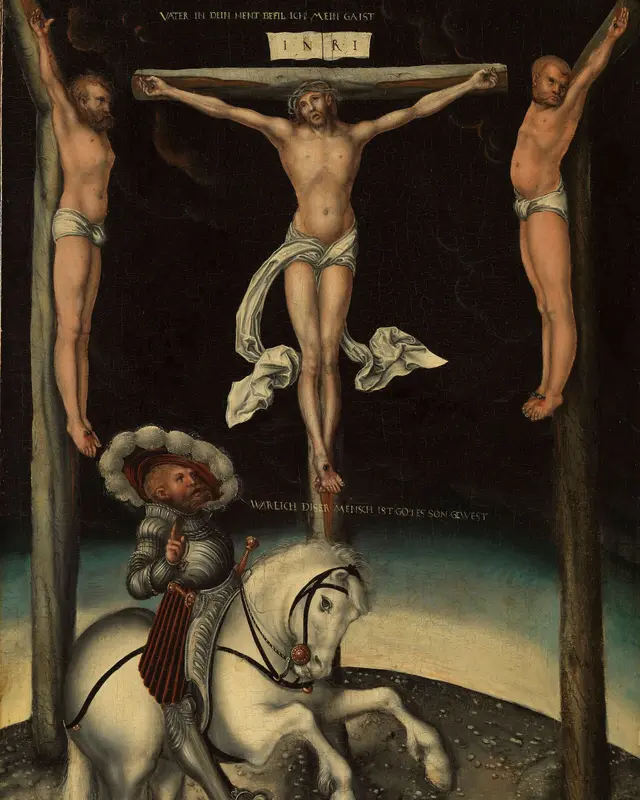
Saint Longinus
The soldier who pierced the side of Jesus, named only in later tradition
- Rank
- Saint
- Kind
- Martyr, Biblical figure
- Feast
- 16 October
- Countries
- Italy, Türkiye
Life story
The Gospels never give the soldier's name. John 19 says that after Jesus had died, one of the soldiers pierced his side with a spear and blood and water came out at once. In Matthew 27, Mark 15 and Luke 23, a Roman centurion standing near the cross says, after seeing how Jesus died, that this man was truly righteous or the Son of God. The Gospels do not say that the two men are the same person.
The name Longinus appears only later, in writings outside the Bible and in medieval retellings. Some scholars suggest that it may come from the Greek word longche, meaning spear. Those legends usually merge the soldier and the centurion into one man, but that is a reading of later centuries and not something the New Testament states.
According to a late account he was healed when blood from the side of Jesus touched his eyes; he believed, left the army, and was later martyred in Cappadocia. The older Roman Martyrology placed this on 15 March, while the present edition lists him on 16 October. Several churches in Europe and the Near East claim to possess his spear, but there is no firm historical evidence for any of them.
Works and witness
- According to John 19, a soldier pierced the side of Jesus with a spear
- The name Longinus is found only in later tradition, not in the New Testament
- According to tradition, healed of eye trouble, converted and left the army
- According to tradition, martyred in Cappadocia
- Several churches claim his spear; none is proven
Saints from the same country
References
- Gospel according to John
- Gospel according to Matthew
- Martyrologium Romanum
Written by Anawim from documented history. Some details about ancient saints rest on tradition and are marked as such.