

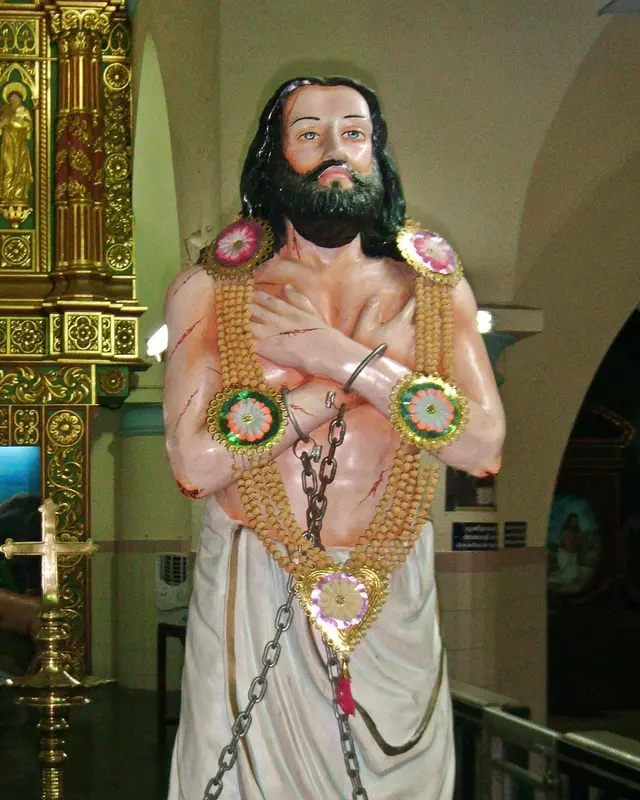
Saint Devasahayam Pillai
A Travancore court official who converted and became India's first lay saint
- Rank
- Saint
- Kind
- Martyr, Layperson
- Life
- 1712 – 1752
- Era
- 18th century
- Feast
- 14 January
- Countries
- India
Life story
He was born on 23 April 1712 at Nattalam in Travancore (now Kanyakumari district, Tamil Nadu) into a Hindu Nair noble family, with the name Neelakanta Pillai. He served in the court of King Marthanda Varma, under the chief minister Ramayyan Dalawa.
Through contact with Captain Eustachius De Lannoy, a Dutch-born officer in the Travancore army, he learned about Christianity and was baptised in 1745, taking the name Lazarus, Devasahayam in Tamil, meaning help of God. A court official abandoning Hinduism was seen by the authorities as unacceptable.
He was arrested, held for about three years and then exiled, at one stage being paraded on a buffalo and badly treated. He died on 14 January 1752 at Kattadimalai near Aralvaimozhy; church sources say he was shot. His body was buried at St Xavier's church in Kottar, Nagercoil, now the cathedral.
The Church recognises him as a martyr for the faith. Some Hindu organisations and historians argue instead that he was executed for sedition, so the reason for his death remains debated. He was beatified on 2 December 2012 at Nagercoil and canonised on 15 May 2022, the first Indian layman not belonging to a religious institute to be raised to the altars.
Works and witness
- Served at the Travancore court under King Marthanda Varma
- Baptised in 1745 and took the name Lazarus Devasahayam
- Imprisoned for about three years, then exiled
- Shot on 14 January 1752
- Beatified in 2012 and canonised on 15 May 2022
Patron of
Laity of India (decree of 16 July 2025)
Saints from the same country
References
- Vatican decrees on the cause of Devasahayam Pillai (beatification 2012, canonisation 2022)
- Holy See Press Office, canonisation Mass of 15 May 2022
- Martyrologium Romanum (14 January)
Written by Anawim from documented history. Some details about ancient saints rest on tradition and are marked as such.