

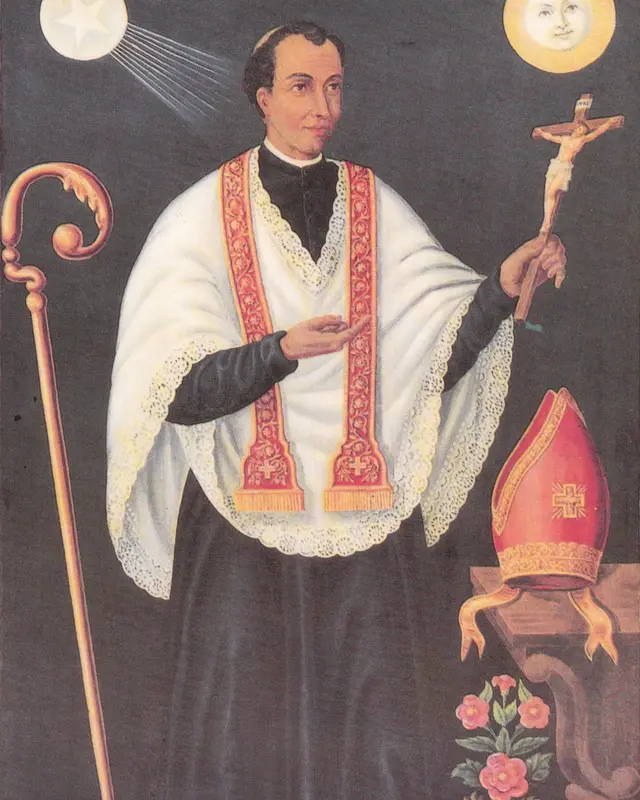
Saint Joseph Vaz
A Goan priest who kept the Catholic faith alive in Sri Lanka under persecution
- Rank
- Saint
- Kind
- Priest, Missionary
- Life
- 1651 – 1711
- Era
- 18th century
- Feast
- 16 January
- Countries
- India, Sri Lanka
Life story
Joseph Vaz was born on 21 April 1651 at Benaulim in Goa, then part of Portuguese India. He studied in Goa, was ordained a priest in 1676 and worked for several years in the Kanara region, where he showed a gift for serving communities with few priests.
At that time the coastal regions of Sri Lanka, then called Ceylon, were under the Dutch East India Company. The Calvinist authorities banned Catholic priests and closed churches. In 1687 Joseph Vaz arrived on the island, dressed as a beggar to avoid detection, travelling from village to village to celebrate the sacraments for believers and gradually building a network of helpers.
He later reached the inland kingdom of Kandy. According to historical sources he was held for a time on suspicion of being a spy, but he was afterwards allowed by the king to work openly, especially after he helped care for the sick during a smallpox epidemic. He gathered a group of priests from Goa to work with him, on the model of an Oratory.
Joseph Vaz died in Kandy on 16 January 1711. John Paul II beatified him in Colombo in 1995, and Pope Francis canonised him, also in Colombo, on 14 January 2015. He is often called the apostle of Sri Lanka. His feast is kept on 16 January, the day of his death, and his canonisation was one of the main events of Pope Francis's visit to Sri Lanka.
Works and witness
- Worked in Kanara before going to Sri Lanka in 1687
- Ministered in secret under a Dutch ban on Catholic priests
- Cared for the sick during a smallpox outbreak in Kandy
- Gathered a group of Goan priests to continue the mission
- Beatified in 1995 and canonised in 2015
Saints from the same country
References
- Martyrologium Romanum
- Dicastery for the Causes of Saints – biographical profile
- Sebastian Pinto, biographical studies of Joseph Vaz
Written by Anawim from documented history. Some details about ancient saints rest on tradition and are marked as such.