

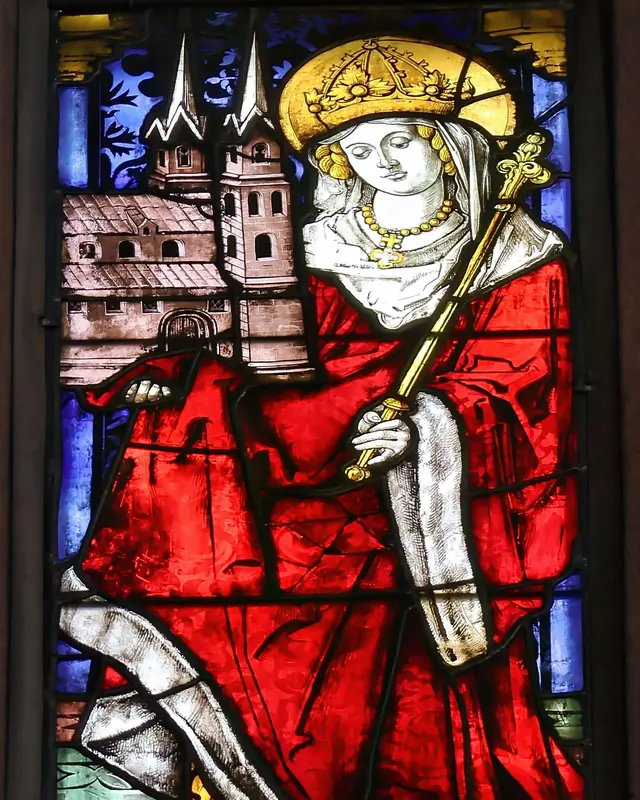
Saint Kunigunde
Empress from Luxembourg, wife of Saint Henry II, founder of Kaufungen abbey
- Rank
- Saint
- Kind
- Royalty, Religious
- Life
- 980 – 1040
- Era
- 11th century
- Feast
- 3 March
- Countries
- Germany
Life story
Kunigunde was born around 980, a daughter of Count Siegfried of Luxembourg. Around 1000 she married Henry, then duke of Bavaria. In 1002, when Henry was elected king, she was crowned queen at Paderborn, and on 14 February 1014 she was crowned empress with him in Rome. The couple had no children.
Court documents show Kunigunde taking part in government, especially when her husband was away, and supporting the founding of the diocese of Bamberg. She also founded a Benedictine nunnery at Kaufungen in Hesse around 1017. A legend says she was once accused of infidelity and proved her innocence by walking barefoot over red-hot ploughshares without injury, but this is only a legend with no historical support.
After Henry died in 1024 she oversaw the choice of his successor and then, in 1025, a year later, entered Kaufungen as a nun. She died on 3 March 1040 and was buried at Bamberg beside her husband. In 1200 Pope Innocent III declared her a saint. Her feast is 3 March, and the people of Luxembourg honour her as one of the national patron saints.
Her tomb in Bamberg cathedral, carved by Tilman Riemenschneider in the early sixteenth century, lies beside her husband's. The abbey at Kaufungen she founded continued for centuries, and her memory remains strong in both Germany and Luxembourg, where she appears among the figures honoured in the national tradition.
Works and witness
- Married Henry II around 1000 and was crowned queen in 1002
- Crowned empress with him in Rome on 14 February 1014
- Founded a Benedictine nunnery at Kaufungen around 1017
- Entered Kaufungen in 1025 after her husband's death
- Canonised by Pope Innocent III in 1200
Patron of
Luxembourg
Saints from the same country
References
- Martyrologium Romanum
- Encyclopaedia Britannica – Saint Cunegund
- Vita Cunegundis (Bamberg tradition)
Written by Anawim from documented history. Some details about ancient saints rest on tradition and are marked as such.