

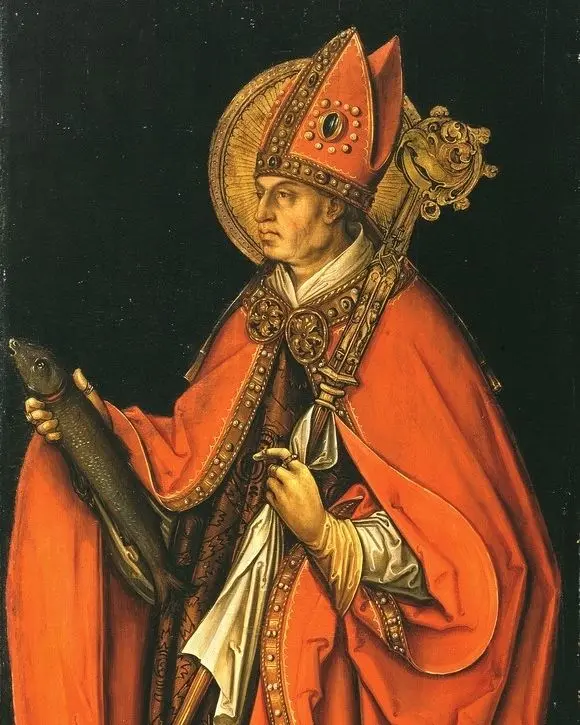
Saint Ulrich of Augsburg
Bishop of Augsburg for fifty years and defender of the city against the Magyars
- Rank
- Saint
- Kind
- Bishop
- Life
- 890 – 973
- Era
- 10th century
- Feast
- 4 July
- Countries
- Germany
Life story
Ulrich was born around 890 into a noble Swabian family and was educated at the abbey of St Gall. He served in the diocese of Augsburg under Bishop Adalbero and was appointed bishop of Augsburg by King Henry I in 923. He governed the diocese for almost fifty years, ordaining priests, restoring churches and visiting parishes.
In his time the Magyars repeatedly swept into southern Germany. Ulrich had the walls of Augsburg rebuilt, along with the damaged cathedral. In 955 the Magyars besieged Augsburg, where he and the townspeople held out until King Otto I arrived, and Otto's army won the battle of the Lechfeld on 10 August 955. A legend says Ulrich took part in the fighting himself, but reliable sources say this is untrue; he stayed in the city, praying and directing its defence.
Ulrich also advised Emperor Otto I, and late in life he arranged for his nephew Adalbero to assist him as coadjutor bishop. He died on 4 July 973. In 993 Pope John XV declared him a saint, and this is regarded as the first clearly documented canonisation made by a pope rather than by local authority. His feast is 4 July.
His burial place, the church of Saints Ulrich and Afra in Augsburg, grew into one of the city's main pilgrimage sites, and the present basilica there dates from the late Middle Ages. Augsburg still keeps his memory alive, and he remains closely tied to the identity of the city and its diocese.
Works and witness
- Bishop of Augsburg from 923 to 973
- Rebuilt the walls and cathedral of Augsburg after raids
- Held Augsburg during the Magyar siege of 955
- Advised King Otto I of Germany
- Canonised by Pope John XV in 993
Saints from the same country
References
- Vita Sancti Oudalrici (Gerhard of Augsburg)
- Martyrologium Romanum
- Encyclopaedia Britannica – Saint Ulrich
Written by Anawim from documented history. Some details about ancient saints rest on tradition and are marked as such.