

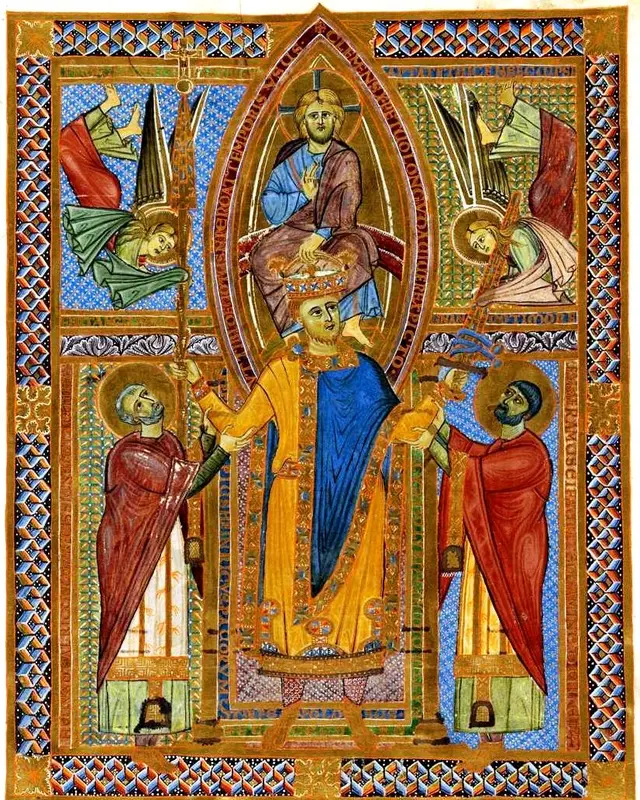
Saint Henry II, Holy Roman Emperor
The last Ottonian emperor, founder of the diocese of Bamberg
- Rank
- Saint
- Kind
- Royalty
- Life
- 973 – 1024
- Era
- 11th century
- Feast
- 13 July
- Countries
- Germany, Italy
Life story
Henry was born in 973 or 972, the son of Duke Henry the Quarrelsome of Bavaria. He succeeded his father as duke in 995 and was educated by clergy, notably at Hildesheim. In 1002 Emperor Otto III died childless, and Henry was elected king by the princes and crowned at Mainz. He married Kunigunde of Luxembourg, but the couple had no children, and he became the last ruler of the Ottonian line.
During his reign Henry led several campaigns in Italy and fought King Bolesław I of Poland until the peace of Bautzen in 1018. On 14 February 1014 Pope Benedict VIII crowned him emperor in Rome. He supported monastic reform, gave generous gifts to the Church, and in 1007 founded the diocese of Bamberg, whose cathedral was consecrated in 1012. He placed the new see on the eastern frontier in order to strengthen missionary work.
Henry died on 13 July 1024 at Grone near Göttingen and was buried in Bamberg cathedral. Pope Eugene III declared him a saint in 1146, more than a century after his death. Historians describe him as a practical and at times hard-edged ruler, whom contemporaries remembered for his care for the Church. His feast is 13 July.
The cathedral he founded still stands in Bamberg, where his tomb, carved by the sculptor Tilman Riemenschneider in the early sixteenth century, shows him beside Kunigunde. The city is now a World Heritage site, and the memory of the emperor remains central to its identity.
Works and witness
- Duke of Bavaria from 995 and elected king of Germany in 1002
- Crowned emperor in Rome by Benedict VIII on 14 February 1014
- Founded the diocese of Bamberg in 1007; cathedral consecrated in 1012
- Concluded the peace of Bautzen with Poland in 1018
- Canonised by Pope Eugene III in 1146
Saints from the same country
References
- Martyrologium Romanum
- Encyclopaedia Britannica – Henry II
- Thietmar of Merseburg – Chronicon
Written by Anawim from documented history. Some details about ancient saints rest on tradition and are marked as such.