

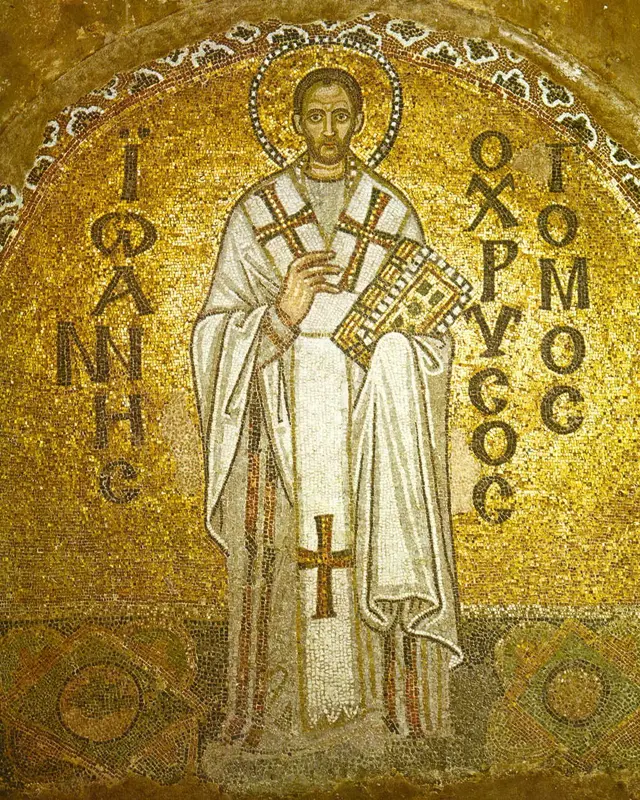
Saint John Chrysostom
Preacher of Antioch, archbishop of Constantinople who died in exile
- Rank
- Saint
- Kind
- Bishop, Doctor of the Church
- Life
- ~349 – 407
- Era
- 5th century
- Feast
- 13 September
- Countries
- Türkiye, Syria
Life story
John was born around 349 in Antioch, today in Turkey, into a family of good standing; his father died early and his mother Anthusa raised him. He studied rhetoric under Libanius and then turned to an ascetic life, spending several years as a hermit in the hills near the city. Failing health forced him to return, and in 386 he was ordained priest.
For about twelve years in Antioch he preached regularly, expounding Scripture book by book and reminding the wealthy of their duties to the poor. The title Chrysostom, meaning Golden Mouth, was attached to him from the sixth century onward.
In 397 or 398 he was brought to Constantinople as archbishop. He reformed the clergy's way of life and criticised luxury at court, which earned him the enmity of the empress Eudoxia and of Theophilus, bishop of Alexandria. In 403 a synod held at the Oak near Chalcedon condemned and deposed him. He was exiled, recalled, then exiled again in 404.
On a forced march to a remote place on the Black Sea coast he collapsed from exhaustion and died on 14 September 407 near Comana in Pontus. He is honoured as a Doctor of the Church. Hundreds of his homilies survive, and in 438 his remains were brought back to Constantinople with honour under the emperor Theodosius II. A liturgy bearing his name is still celebrated in churches of the Byzantine rite.
Works and witness
- Preached and expounded Scripture for about twelve years in Antioch
- Archbishop of Constantinople from 397 or 398
- Deposed in 403 and exiled twice
- Died near Comana in Pontus on the road to exile in 407
Patron of
Preachers, Orators
Saints from the same country
References
- John Chrysostom, Homilies
- Palladius, Dialogue on the Life of John Chrysostom
- Martyrologium Romanum
Written by Anawim from documented history. Some details about ancient saints rest on tradition and are marked as such.