

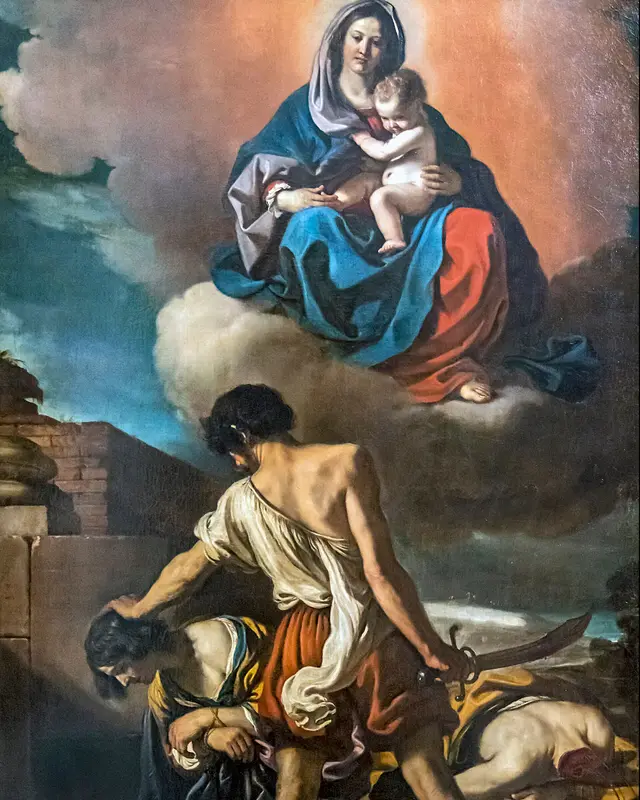
Saints John and Paul
Two Roman martyrs whose church still stands on the Caelian Hill
- Rank
- Saint
- Kind
- Martyr
- Life
- d. ~362
- Era
- 4th century
- Feast
- 26 June
- Countries
- Italy
Life story
Only one point is treated as secure: John and Paul are martyrs of the Roman Church, honoured there from an early date. The Catholic Encyclopedia stresses that the details of their death have no historical foundation.
According to their Acts, which are legendary, the two were officers or court officials under Constantine, serving his daughter Constantia. When the emperor Julian (who ruled 361 to 363 and is called the Apostate) asked them to return to service, they refused. They were given ten days to reconsider, during which they gave away their wealth to the poor, and were then beheaded in secret in their own house on the Caelian Hill, around 362 according to the Acts.
Tradition says they were buried in the house itself. The senator Byzantius and his son Pammachius turned the house into a basilica; by the fifth century the tomb was venerated and the site was known as the titulus of the two martyrs. Today it is the Basilica of Santi Giovanni e Paolo in Rome, which contains early Christian frescoes.
Their names are in the Roman Canon. Their feast is kept on 26 June, the day taken to be that of their martyrdom.
Works and witness
- Honoured as martyrs of the Roman Church
- By the legendary Acts, executed in secret on the Caelian Hill under Julian
- Their house was turned into a basilica by Byzantius and Pammachius
- Named in the Roman Canon; feast on 26 June
Saints from the same country
References
- Catholic Encyclopedia (New Advent), Sts. John and Paul (newadvent.org/cathen/08443a.htm)
- Britannica, Santi Giovanni e Paolo church, Rome
- Britannica, Julian (Roman emperor)
Written by Anawim from documented history. Some details about ancient saints rest on tradition and are marked as such.