

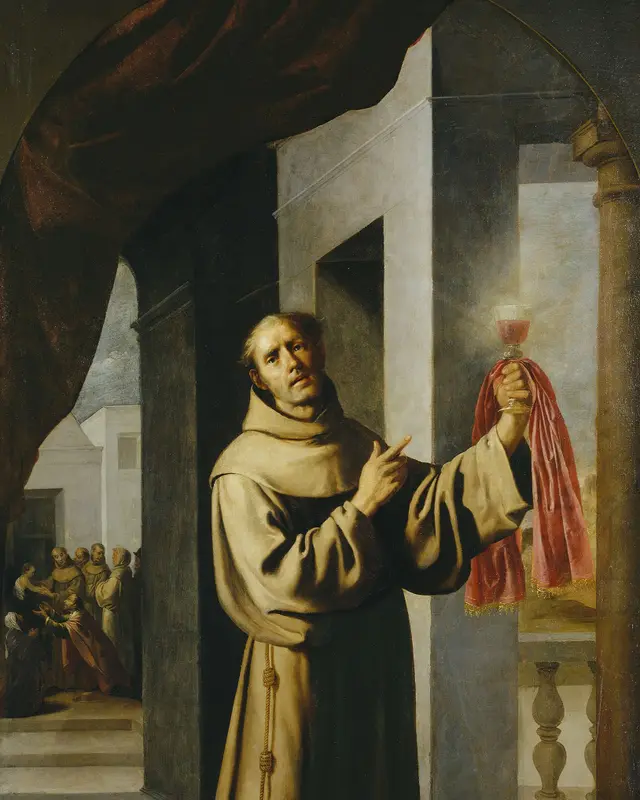
Saint James of the Marches
Franciscan preacher across Europe who helped found low-interest Monti di Pietà
- Rank
- Saint
- Kind
- Priest, Religious
- Life
- d. 1476
- Era
- 15th century
- Feast
- 28 November
- Countries
- Italy
Life story
James was born at Monteprandone in the March of Ancona to a poor family, in about 1391 according to the Catholic Encyclopedia. He studied at Offida and Ascoli, then took a doctorate in law at the University of Perugia. Sources differ by a few years on his birth, so 1391 is approximate. On 26 July 1416 he joined the Friars Minor at the Portiuncula in Assisi, taking the name James, and was ordained a priest on 13 June 1420.
He preached for decades, first in Tuscany, the Marches and Umbria, later on journeys to Germany, Austria, Sweden, Denmark, Bohemia, Poland, Hungary and Bosnia, where he also served as commissary of the order. He fought the Fraticelli and, at the Council of Basel, promoted the union of moderate Hussites with the Church. He founded several montes pietatis in Italy, lending institutions with very low interest, to counter usury. In 1460 he declined the bishopric of Milan.
In 1462 a sermon on the Precious Blood led the inquisitor James of Brescia to summon him; he appealed to the Holy See, and Rome reached no decision. He spent his last three years in Naples and died there on 28 November 1476, buried in the church of Santa Maria la Nuova. Urban VIII beatified him in 1624 and Benedict XIII canonised him in 1726. He is usually shown holding a chalice with a snake escaping from it, an allusion to attempts to poison him.
Works and witness
- Joined the Friars Minor at the Portiuncula on 26 July 1416
- Ordained a priest on 13 June 1420
- Preached across Europe and served in Bosnia
- Founded several Monti di Pietà, low-interest lenders
- Died in Naples on 28 November 1476; canonised in 1726
Saints from the same country
References
- Catholic Encyclopedia (New Advent), 'St. James of the Marches', 1910
- Catholic Encyclopedia (New Advent), 'James of Brescia'
Written by Anawim from documented history. Some details about ancient saints rest on tradition and are marked as such.