

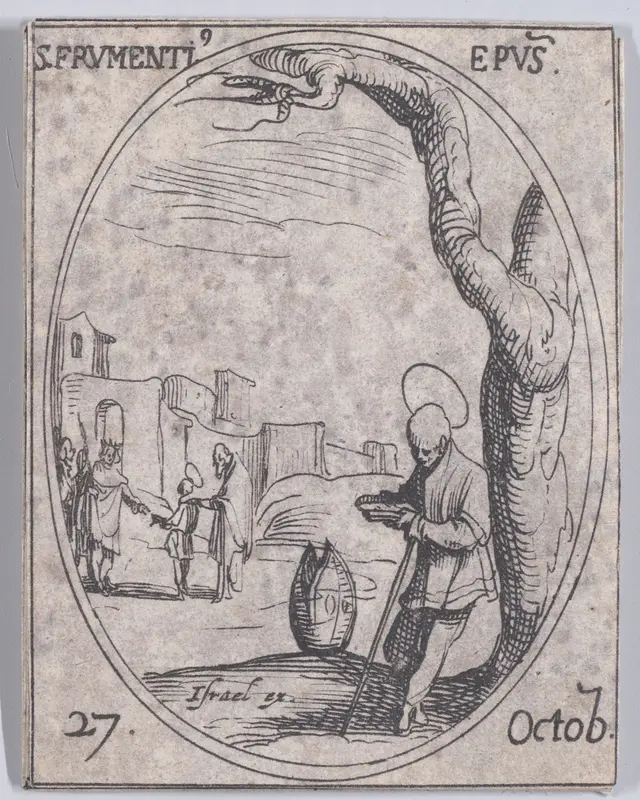
Saint Frumentius
First bishop of Axum who brought Christianity to Ethiopia
- Rank
- Saint
- Kind
- Bishop, Missionary
- Life
- d. ~383
- Era
- 4th century
- Countries
- Ethiopia, Lebanon, Eritrea
Life story
The main source for Frumentius is the fourth-century historian Rufinus, who drew on the account of Frumentius's brother Edesius. According to it, around 316 two young men from Tyre (now in Lebanon), Frumentius and Edesius, sailed with their uncle, the philosopher Meropius, toward a region called India. When the ship put in at a Red Sea harbour, the crew was killed and the two brothers were taken to the king of Axum.
Frumentius became the king's secretary and treasurer. When the king died, the brothers were freed, and the queen asked them to stay and help educate the heir, Ezana. Frumentius encouraged Christian merchants to practise openly and gather together; later he built up a community of local believers and, according to tradition, brought Ezana to the faith. Edesius returned to Tyre and became a priest.
Frumentius travelled to Alexandria and asked Bishop Athanasius to send a bishop to Axum. Athanasius chose him and consecrated him, traditionally in 328, though some propose 340–346. He returned and was called Abba Salama, Father of Peace, by the Ethiopians. Around 356–357 the emperor Constantius II wrote to the Axumite rulers asking them to replace him with a bishop of the Arian party; the outcome is unclear. He died around 383. His feast varies by tradition: the Eastern Orthodox Church keeps 30 November and the Coptic Church 18 December.
Works and witness
- Enslaved at Axum around 316
- Became secretary and treasurer of the king, then tutor of Ezana
- Helped Christian merchants organise a community
- Consecrated bishop by Athanasius of Alexandria
- Known to Ethiopians as Abba Salama
Patron of
Ethiopia
Saints from the same country
References
- Rufinus of Aquileia, Ecclesiastical History, book I
- Athanasius of Alexandria, Apology to Constantius
- Martyrologium Romanum
Written by Anawim from documented history. Some details about ancient saints rest on tradition and are marked as such.