

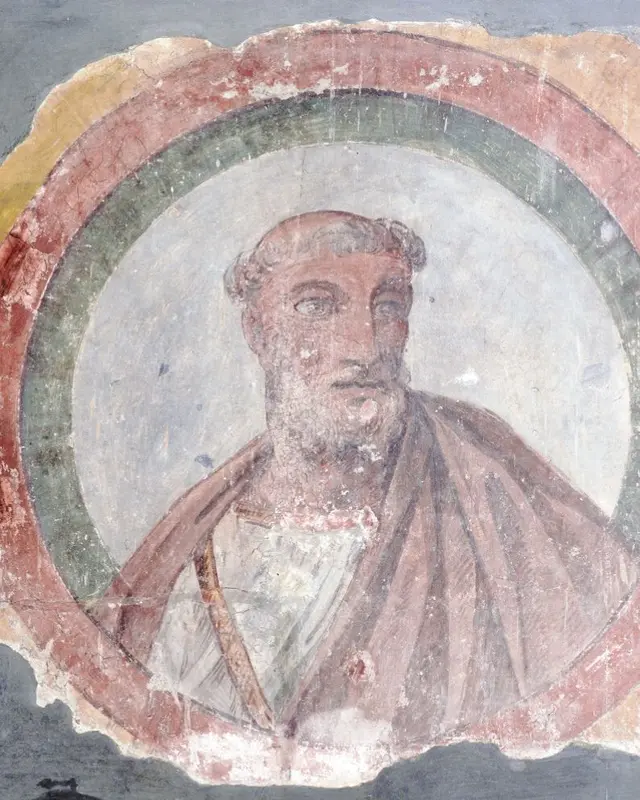
Saint Callixtus I
Early third-century pope, a former slave who ran the cemetery on the Appian Way
- Rank
- Saint
- Kind
- Pope, Martyr
- Life
- d. ~222
- Era
- 3rd century
- Feast
- 14 October
- Countries
- Italy
Life story
Most of what we know about Callixtus comes from Hippolytus, a bitter opponent, so it must be read with caution. According to Hippolytus, he was born a slave of a Christian named Carpophorus, was put in charge of Christians' funds, lost the money, and was condemned to the mines of Sardinia after being denounced as a Christian. He was later freed through the intervention of a person with influence at court.
Around 199 Pope Zephyrinus made him a deacon and put him in charge of the Christian cemetery on the Appian Way, now known as the Catacombs of Callixtus. Around 217 he was elected bishop of Rome. Hippolytus accused him of being too lenient, because he allowed serious sins, including adultery, to be forgiven for those who repented; Hippolytus opposed him and is counted as the first antipope.
He died around 222 or 223. Catholic tradition counts him as a martyr, but the details, such as being thrown into a well, appear only in the Acts of Saint Callixtus, a late apocryphal text, and are uncertain. According to the Liber Pontificalis he was buried in the cemetery of Calepodius on the Via Aurelia; his relics were later moved to Santa Maria in Trastevere in the ninth century. His feast day is 14 October, and he is cited as a patron of cemetery workers.
Works and witness
- Born a slave and condemned to the Sardinian mines
- Managed the Christian cemetery on the Appian Way
- Pope from about 217 to 222
- Allowed forgiveness of serious sins for the repentant, clashing with Hippolytus
- According to tradition, martyred in Rome around 222
Patron of
Cemetery workers
Saints from the same country
References
- Hippolytus of Rome, Refutation of All Heresies, Book 9
- Liber Pontificalis (life of Callixtus)
- Martyrologium Romanum (14 October)
Written by Anawim from documented history. Some details about ancient saints rest on tradition and are marked as such.