

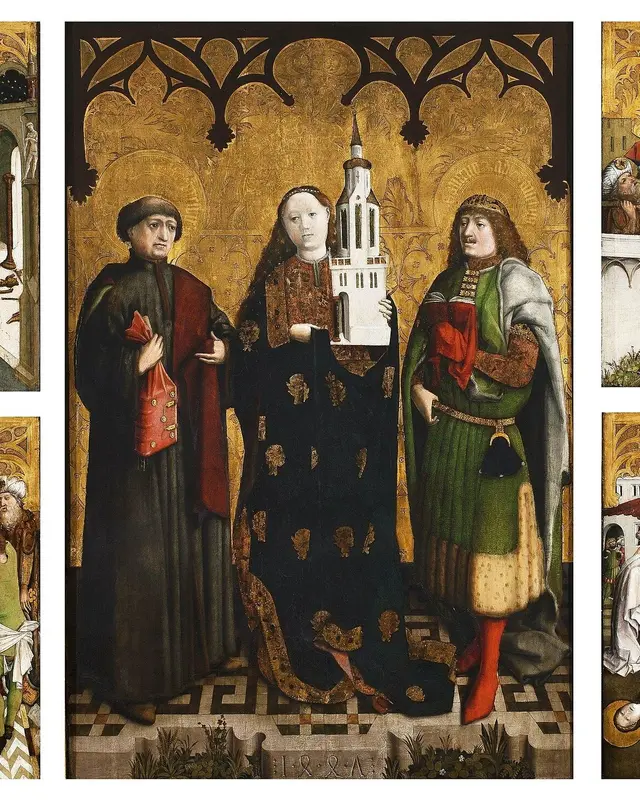
Saint Barbara
A widely venerated woman martyr whose biography is largely legend
- Rank
- Saint
- Kind
- Martyr, Virgin
- Life
- d. ~306
- Era
- 4th century
- Feast
- 4 December
- Countries
- Türkiye
Life story
Barbara is one of the best-loved women saints in both East and West, yet historians admit that almost no contemporary evidence about her survives. Her story is told in an account that appears from about the seventh century onward, and the versions differ on where she lived, naming sometimes Nicomedia and sometimes Heliopolis in Egypt. The place and year of her death, often given as around 306, should therefore be understood as traditional.
According to that tradition, Barbara was the daughter of a wealthy man named Dioscorus. He shut his daughter in a tower to protect her from suitors. While there, she is said to have come to know Christianity and asked for baptism. When her father found out, he tried hard to make her renounce the faith and then handed her over to the governor. She was tortured and beheaded, and legend says it was her own father who struck the blow, after which he was killed by lightning. The detail of the tower with three windows is a symbolic element added later.
Although the story's authenticity is much doubted, devotion to Barbara spread widely through East and West during the Middle Ages. She was counted among the Fourteen Holy Helpers, and several dangerous trades chose her as protector, notably miners and artillerymen. In 1969 the general liturgical calendar of the Roman Church dropped her commemoration because of the lack of historical evidence, but she remains listed in the Roman Martyrology and is still venerated in many places.
Works and witness
- Tradition says she was a rich man's daughter shut in a tower by her father
- By tradition, executed around 306 for refusing to renounce her faith
- Counted among the Fourteen Holy Helpers
- Chosen as protector by miners and artillerymen
- Her feast left the general calendar in 1969 for lack of evidence
Patron of
Artillerymen, Miners
Saints from the same country
References
- Martyrologium Romanum
- Passio S. Barbarae (later Greek and Latin versions)
- Dicastery for the Causes of Saints – biographical profile
Written by Anawim from documented history. Some details about ancient saints rest on tradition and are marked as such.