

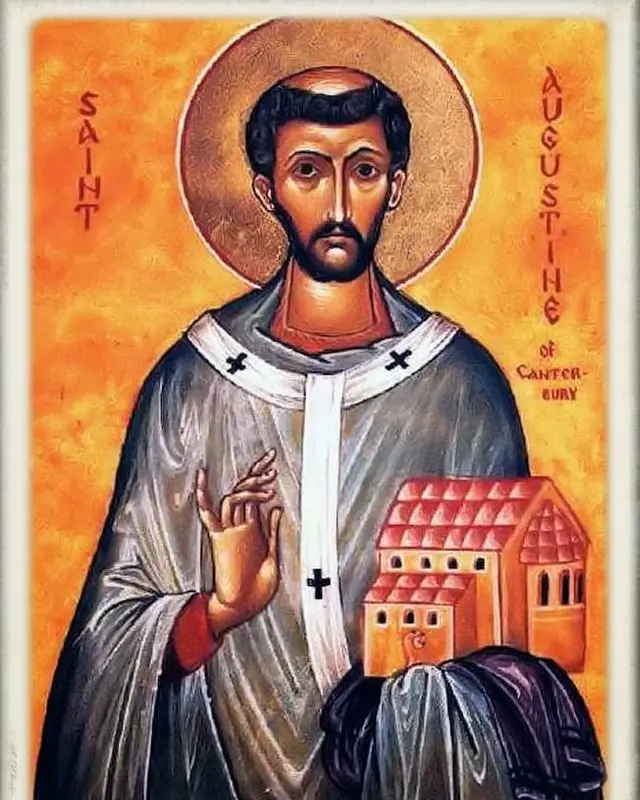
Saint Augustine of Canterbury
Monk sent by Gregory the Great whose mission to the Anglo-Saxons began in 597
- Rank
- Saint
- Kind
- Bishop, Missionary
- Life
- d. 604
- Era
- 7th century
- Feast
- 27 May
- Countries
- Italy, United Kingdom
Life story
Augustine was prior of the monastery of St Andrew on the Caelian Hill in Rome, a community that Gregory the Great himself had founded. His year of birth and place of origin are not known. In 596 Gregory chose him to lead a group of about forty monks to England to preach the gospel to the Anglo-Saxons. On the way the group grew afraid of an unfamiliar people, so Augustine went back to ask the pope to call off the journey, but the pope urged them to continue.
The party landed on the Isle of Thanet in the kingdom of Kent in 597. King Æthelberht of Kent had a Frankish Christian wife, Queen Bertha, and he allowed the monks to stay and teach at Canterbury. Not long after, the king accepted baptism, and many of his people followed. Augustine was consecrated bishop in Gaul at Gregory's direction, then set up his see at Canterbury, using an old Roman-era church, and founded a monastery nearby which later took his name.
Augustine also sent others to establish further dioceses at Rochester and London, but his meetings with the older British bishops in the west did not lead to agreement. He died at Canterbury around 604 and was buried there. The English Church regards him as the founder of Anglo-Saxon Christianity, hence his title Apostle of the English, and his feast is kept on 27 May.
Works and witness
- Prior of St Andrew's monastery in Rome, sent to England by Gregory the Great in 596
- Arrived in Kent in 597 and was allowed to preach by King Æthelberht
- Became bishop and set up the see of Canterbury
- Established further dioceses at Rochester and London
- Died around 604; called the Apostle of the English
Saints from the same country
References
- Bede, Historia ecclesiastica gentis Anglorum
- Gregory the Great, Registrum epistularum
- Martyrologium Romanum
Written by Anawim from documented history. Some details about ancient saints rest on tradition and are marked as such.