

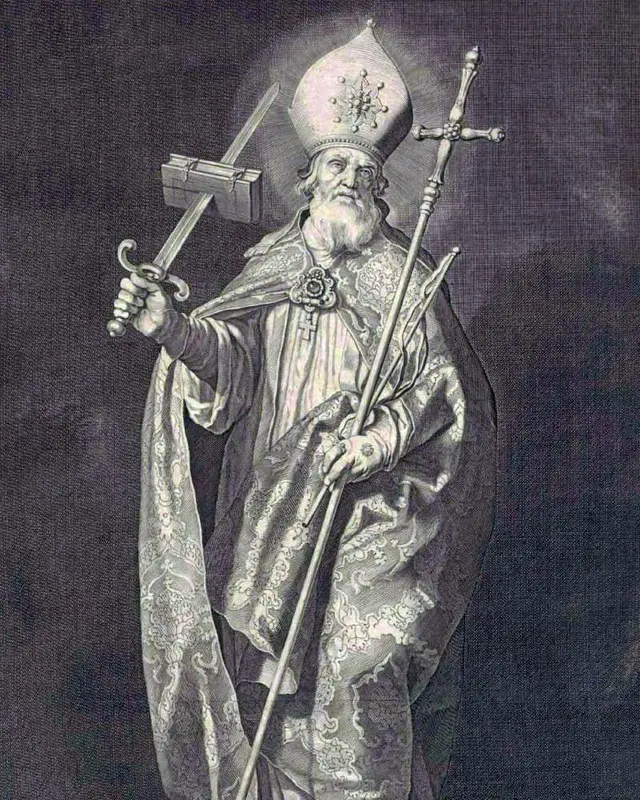
Saint Boniface
English missionary known as the Apostle of Germany, killed in Frisia in 754
- Rank
- Saint
- Kind
- Bishop, Martyr, Missionary
- Life
- 675 – 754
- Era
- 8th century
- Feast
- 5 June
- Countries
- United Kingdom, Germany, Netherlands
Life story
Boniface was born Wynfrith around 675 in the kingdom of Wessex in southern England. He entered a monastery under the Rule of Benedict and became a priest and teacher at the monastery of Nursling. In 716 he tried to carry out missionary work in Frisia, but the attempt failed because of war. In 719 Pope Gregory II entrusted him with preaching the gospel in Germania and gave him the name Boniface.
Over the following decades he worked in Hesse, Thuringia and Bavaria. According to an early account, he felled a great oak sacred to the god Donar at Geismar, around 723, as a sign of ending idol worship; this detail comes from a biography written after his time and may have been embellished. In 732 he was made missionary archbishop, and afterwards he founded several new dioceses and reformed the Church in Frankish lands under the protection of the Carolingian rulers. In 744 he founded the monastery of Fulda, which later became a major religious and cultural centre.
In old age Boniface returned to Frisia to continue the mission. On 5 June 754, near Dokkum, he and many companions were killed by a band of raiders. His body was brought to Fulda and buried there, and his tomb still lies in Fulda cathedral. He left many letters that survive and are a valuable source for the eighth-century Church. He is honoured as the Apostle of Germany.
Works and witness
- English monk born around 675, given the name Boniface by Gregory II in 719
- Preached in Hesse, Thuringia and Bavaria
- Made missionary archbishop in 732 and founded several dioceses
- Founded the monastery of Fulda in 744
- Killed near Dokkum in Frisia on 5 June 754
Patron of
Germany
Saints from the same country
References
- Willibald, Vita Bonifatii
- The Letters of Saint Boniface
- Martyrologium Romanum
Written by Anawim from documented history. Some details about ancient saints rest on tradition and are marked as such.