

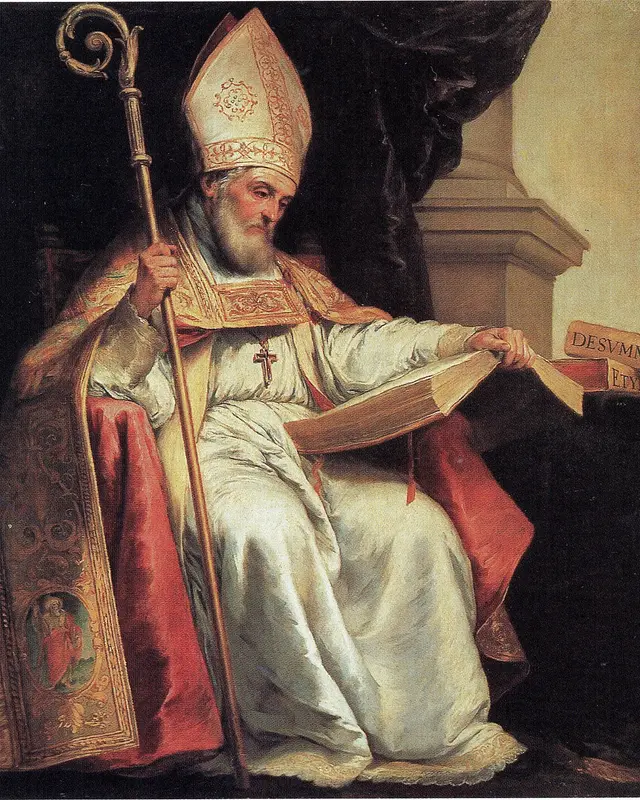
Saint Isidore of Seville
Bishop of Seville and author of the Etymologiae, an encyclopaedia of the early Middle Ages
- Rank
- Saint
- Kind
- Bishop, Doctor of the Church
- Life
- 560 – 636
- Era
- 7th century
- Feast
- 4 April
- Countries
- Spain
Life story
Isidore was born around 560 in Cartagena, in the south-east of Hispania, to an influential family. After his parents died he was brought up by his elder brother Leander, who later became bishop of Seville and held great influence at the Visigothic court. Around 600 Isidore succeeded his brother as bishop of Seville and held the office for more than thirty years, until his death in 636.
During his years as bishop he was the leading figure of the Church in Hispania. He presided over the Council of Seville in 619 and played a prominent part in the Fourth Council of Toledo in 633, which set out many rules on clerical discipline and on the relationship between the king and the Church. He was also concerned with training the clergy and widening education, and encouraged study in schools beside the cathedral. Early sources also mention his care for the poor.
Isidore left a very large body of writing. The Etymologiae, finished after his death with the help of his colleague Braulio, is an encyclopaedia gathering classical knowledge of grammar, medicine, law, astronomy, agriculture and many other fields, and it was copied and used widely throughout the Middle Ages. He also wrote a History of the Goths, a book of Sentences, and works on Scripture. He died on 4 April 636 in Seville. Pope Innocent XIII declared him a Doctor of the Church in 1722.
Works and witness
- Bishop of Seville from about 600 to 636, succeeding his brother Leander
- Presided at the Council of Seville in 619 and shaped the Fourth Council of Toledo in 633
- Compiled the encyclopaedic Etymologiae, used throughout the Middle Ages
- Wrote the History of the Goths and works on Scripture
- Declared a Doctor of the Church in 1722
Saints from the same country
References
- Isidore of Seville, Etymologiae
- Braulio of Zaragoza, Renotatio librorum domini Isidori
- Martyrologium Romanum
Written by Anawim from documented history. Some details about ancient saints rest on tradition and are marked as such.