

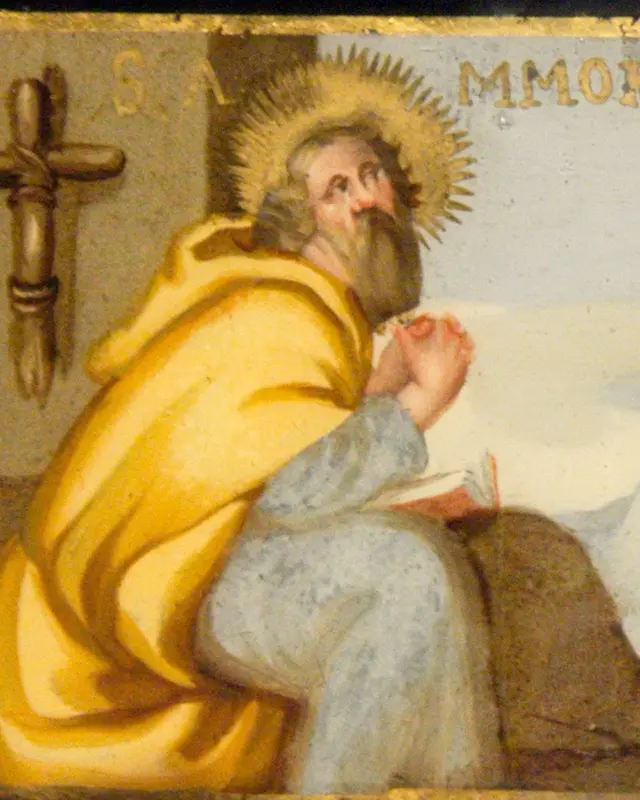
Saint Amun
A married man who lived in chastity and founded the hermit settlement on Mount Nitria
- Rank
- Saint
- Kind
- Religious, Founder
- Countries
- Egypt
Life story
Most of what we know about Amun comes from Palladius's Lausiac History, who tells it on the word of a monk of Nitria. Orphaned at about twenty-two, he was pressured by his uncle into marriage. On the wedding night he persuaded his bride to embrace a life of chastity, and the two lived as brother and sister in the same house for eighteen years. By day he tended balsam gardens and by night he prayed.
At his wife's wish they then parted, so that his virtue could benefit others. He built a dwelling on Mount Nitria, where no monasteries yet existed, and lived there for twenty-two years, visiting his wife twice a year. He died at sixty-two. Palladius gives no calendar dates; reference works usually give about 294 to 356, which is a modern estimate. Palladius reports that some time later about five thousand monks lived around Nitria, with six hundred more living in greater isolation at the Cells (Kellia), twelve miles away.
His name appears in other works too. In Athanasius's Life of Anthony, an anecdote of legendary character tells that an angel carried him and his disciple Theodore across a river without a boat. Palladius relates that Anthony saw Amun's soul carried to heaven by angels. The historians Socrates and Sozomen also mention him. His feast is given as 4 October in the Catholic and Orthodox churches.
Works and witness
- Lived in chastity with his wife for eighteen years
- Built a hermitage on Mount Nitria where no monastery yet stood
- A large monastic settlement formed around it (Palladius says about five thousand monks)
- Mentioned by Athanasius, Palladius, Socrates and Sozomen
Saints from the same country
References
- Palladius, Lausiac History, ch. 8 (Amoun) – tertullian.org translation, read: orphan at about 22, forced marriage, 18 years with his wife, 22 years on Nitria, visits twice a year
- Mystagogy Resource Center (John Sanidopoulos), “Holy Abba Ammoun of Nitria” (4 October) – Athanasius, Socrates, Sozomen
- Wikipedia (English), “Saint Amun” – conventional dates 294–356
Written by Anawim from documented history. Some details about ancient saints rest on tradition and are marked as such.