

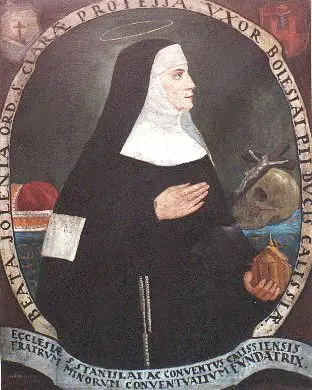
Blessed Yolanda of Poland
Hungarian princess and duchess of Poland who became a Poor Clare abbess in Gniezno
- Rank
- Blessed
- Kind
- Royalty, Religious
- Life
- 1235 – 1298
- Era
- 13th century
- Feast
- 11 June
- Countries
- Hungary, Poland
Life story
Yolanda, also called Jolenta or Helen, was born around 1235 (some sources say 1239) in Esztergom, the daughter of King Béla IV of Hungary and Maria Laskarina. Her sisters were Saint Kinga and Saint Margaret of Hungary, both canonised, and her aunt was Saint Elizabeth of Hungary.
In 1256 or 1257, while visiting Poland, she was encouraged to marry Duke Bolesław the Pious, and the couple had three daughters: Elisabeth, Jadwiga and Anna. Jadwiga later married Władysław I the Elbow-high, who became king of Poland. Sources describe her as devoted to serving the poor and generous toward monasteries, friaries and hospitals, and her husband supported these works so much that he was nicknamed the Pious.
Bolesław died in 1279. Afterwards she, her sister Kinga and her daughter Anna retired to the Poor Clare monastery that Kinga had founded at Stary Sącz. After her sister Kinga died in 1292 she moved to the Poor Clare monastery in Gniezno, which sources attribute to her husband (other accounts say she founded it), and became its abbess.
She died on 11 June 1298 in Gniezno. Pope Leo XII beatified her in 1827. She has not been canonised; her feast is on 11 or 12 June.
Works and witness
- Daughter of King Béla IV of Hungary, born in Esztergom
- Married Duke Bolesław the Pious in 1256 or 1257 and had three daughters
- Supported monasteries, friaries and hospitals and served the poor
- As a widow (1279) joined the Poor Clares, later moved to Gniezno and became abbess
- Beatified by Pope Leo XII in 1827
Saints from the same country
References
- Marypages.com, Blessed Yolanda (Helen) of Poland
- Wikipedia, Yolanda of Poland (cross-check for beatification year and death date)
Written by Anawim from documented history. Some details about ancient saints rest on tradition and are marked as such.