

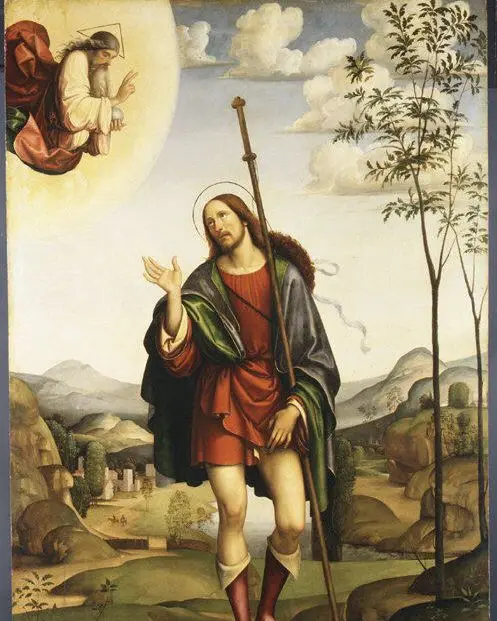
Saint Roch
Pilgrim from Montpellier, honoured for caring for plague victims
- Rank
- Saint
- Kind
- Layperson
- Feast
- 16 August
- Countries
- France, Italy
Life story
The sources for Saint Roch are thin and mixed with legend. The earliest account is an undated text, and in 1478 Francesco Diedo wrote a fuller life. According to tradition he was born in Montpellier to a noble family, with a red cross-shaped birthmark on his chest. When his parents died he gave his wealth to the poor, joined the Franciscan Third Order and set out on pilgrimage to Rome.
The tradition continues that he nursed plague victims in several Italian cities and healed many of them. When he fell ill near Piacenza, a dog is said to have brought him bread and licked his wounds, and he recovered. Later he was arrested on suspicion of spying (in Voghera according to the Italian tradition, in Montpellier according to others), held about five years and died without revealing who he was; the birthmark finally identified him. All of this belongs to legend, not to confirmed history.
His dates are also unclear. Tradition gives his death as 1327, in Montpellier or Voghera, but that is earlier than the great fourteenth-century plague, while modern estimates place his life roughly between 1348 and 1376 or 1379. What is certain is that his body was moved from Voghera to Venice in 1485.
Devotion to him grew sharply during the plague of 1477 to 1479 in northern Italy. Pope Gregory XIV had his name entered in the Roman Martyrology around 1590 to 1591, fixing his feast on 16 August.
Works and witness
- According to tradition, pilgrimage to Rome and care of plague victims in Italy
- Body moved from Voghera to Venice in 1485
- Devotion surged during the plague of 1477 to 1479
- Entered in the Roman Martyrology under Gregory XIV
Patron of
Invoked against plague, The sick, Pilgrims
Saints from the same country
References
- Catholic Encyclopedia, "St. Roch" (newadvent.org/cathen/13100c.htm)
Written by Anawim from documented history. Some details about ancient saints rest on tradition and are marked as such.